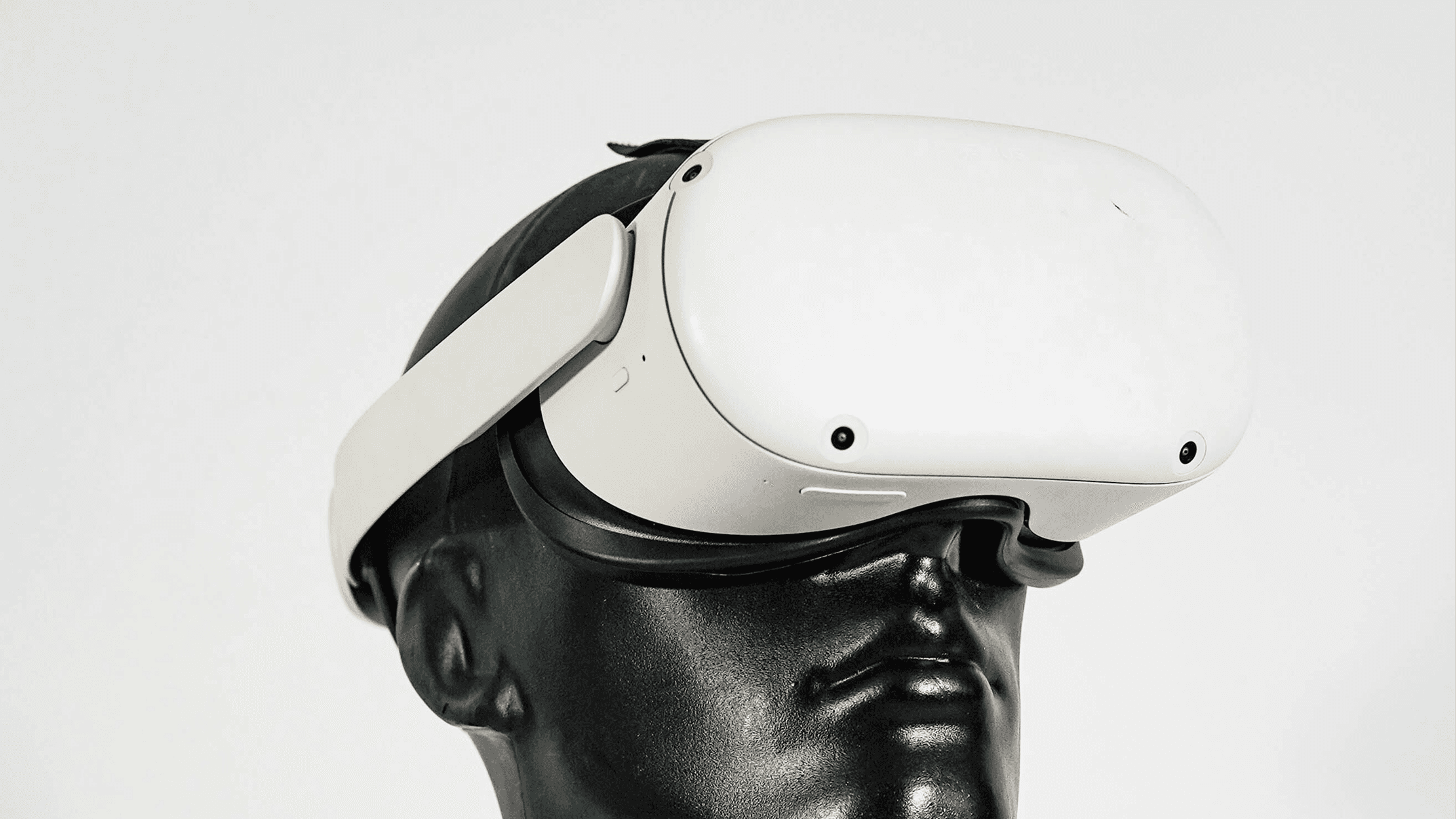
Spatial Collaboration Workspace
Built an immersive VR workspace that reduced context switching by 23%, doubled artifact review speed, and cut validation rework by 64%.
Spatial Collaboration Workspace
Built an immersive VR workspace that reduced context switching by 23%, doubled artifact review speed, and cut validation rework by 64%.
Spatial Collaboration Workspace
Built an immersive VR workspace that reduced context switching by 23%, doubled artifact review speed, and cut validation rework by 64%.
Status & Year
Development (2025-26)
Status
Development (2025-26)
Status & Year
Development (2025-26)
Company
Spatial.io
Company
Spatial.io
Disclaimer
This project is based on real-world experience in a immersive space. Sensitive data, system identifiers, and workflows been modified to maintain confidentiality.
Problem Statement & Challenges
Remote teams rely on fragmented collaboration stacks video calls, whiteboards, task trackers, and chat resulting in constant context switching and cognitive fatigue. The collaboration layer feels distributed rather than shared.
Spatial IO explores how virtual reality can reintroduce a persistent shared workspace one that unifies communication, co-creation, and task management in an environment that feels closer to working side by side.
My Contribution
I led the end-to-end UX design for Spatial IO, mapping collaboration journeys and defining spatial interaction models for immersive teamwork.
My work spanned research synthesis, spatial layout architecture, modular interface systems, and high-fidelity VR prototyping partnering closely with Product and Engineering to bring the experience from concept to handoff.
Design
1 Member
Design
1 Member
Product
1 Member
Product
1 Member
Engg+Data+Ops
1 Member
Engg+Data+Ops
1 Member
Timeline
2 Sprints
Timeline
2 Sprints
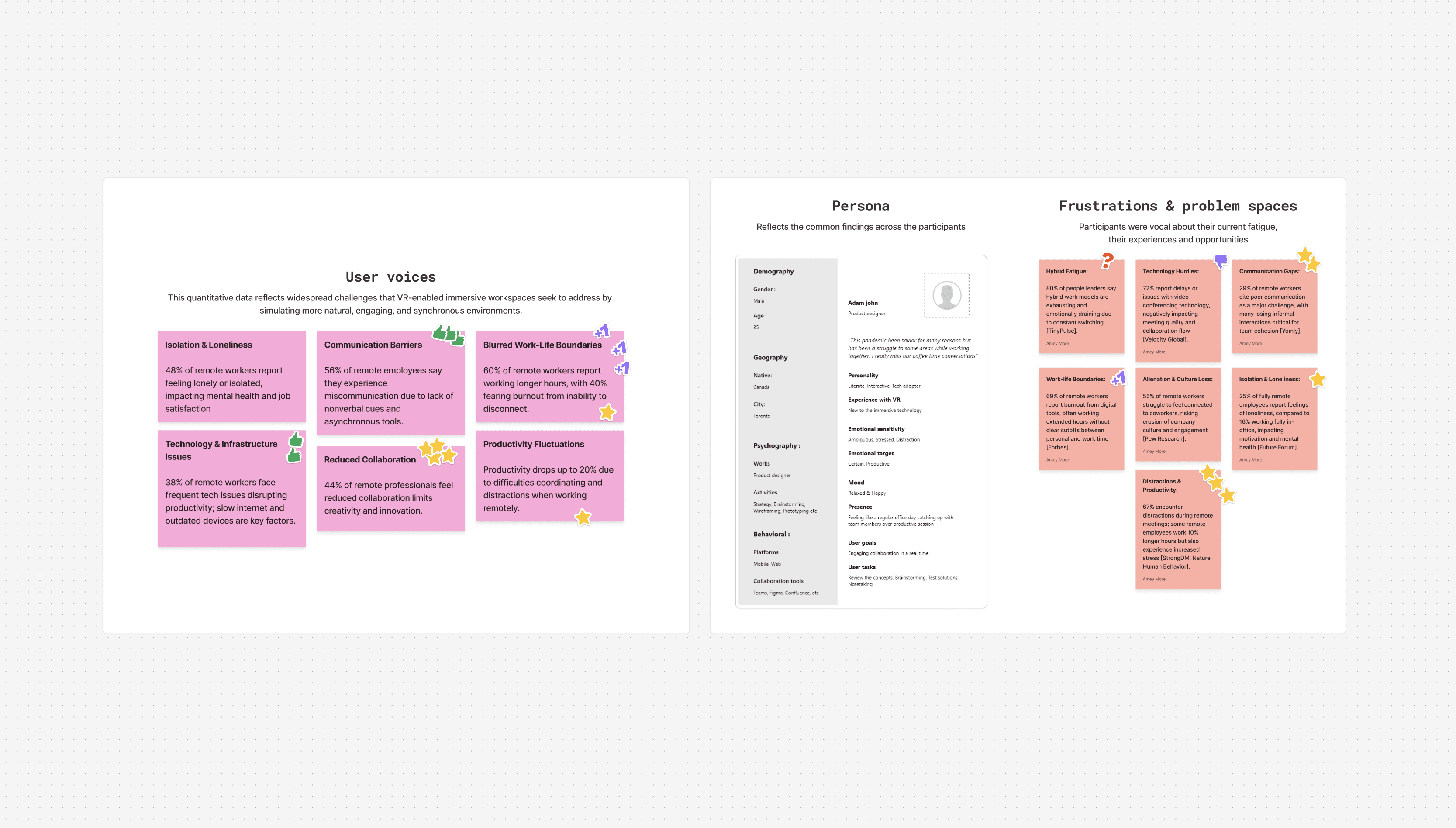
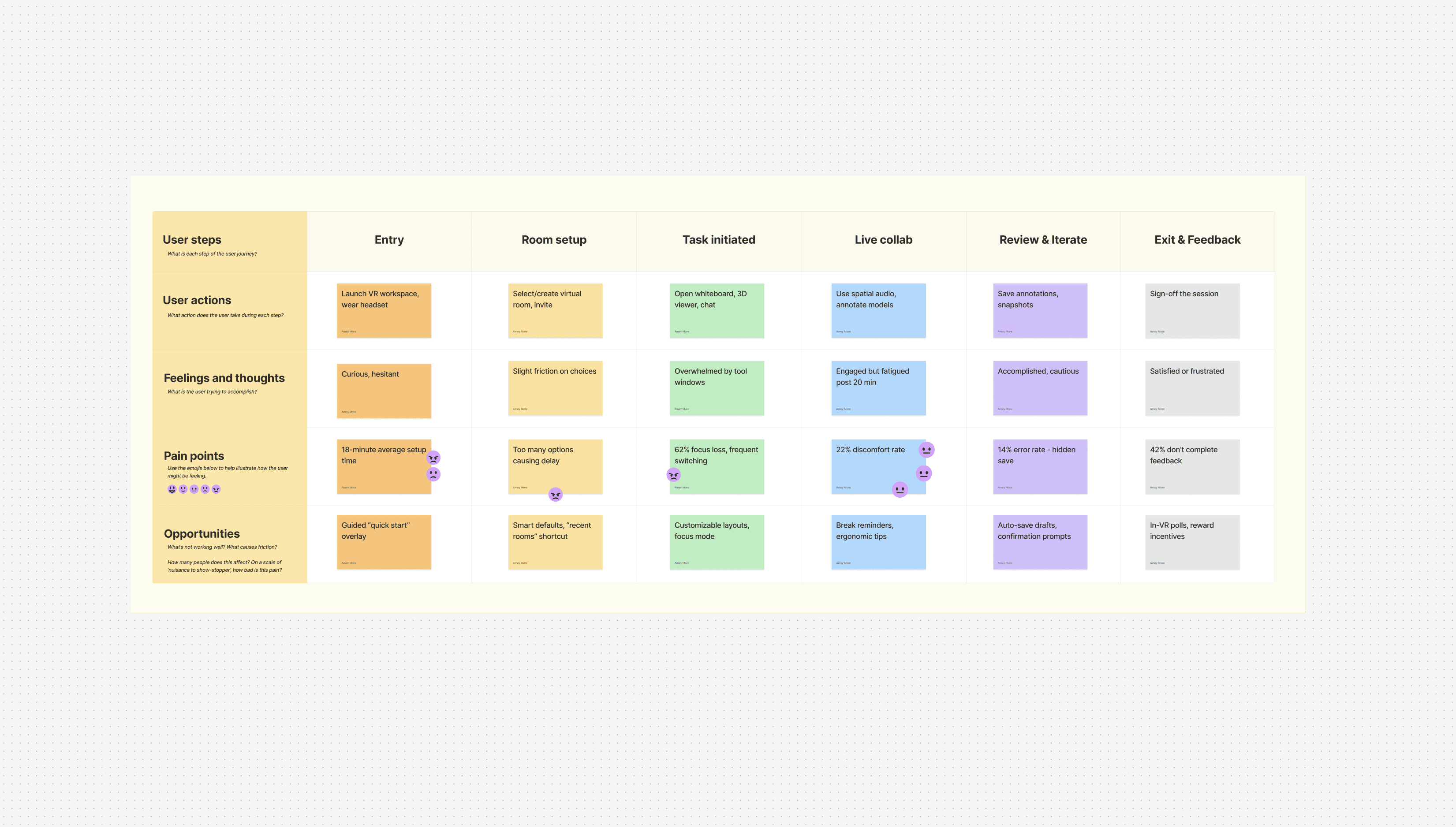
Persona, Jobs to be done
Focus group sessions with product managers, designers, and engineers revealed shared collaboration friction across roles.
Product managers struggled to maintain visibility across fragmented tools. Designers lacked a shared spatial canvas for co-creation and critique. Engineers faced rework driven by misalignment and unclear validation during reviews.
Quantitative signals reinforced this pattern: 71% reported losing time to screen switching, 78% experienced video fatigue, and 62% lost focus in meetings lacking spatial or visual cues.
Extended headset use further introduced physical discomfort during longer sessions.
Our North Star
Create a unified, immersive workspace that eliminates tool switching, supports both synchronous and asynchronous collaboration, and mirrors the natural flow of in-person teamwork without increasing cognitive or physical strain.
Field interaction
15 (Focus group users)
Research
15 (Focus group users)
Field interaction
15 (Focus group users)
System logs
~330 Millions (Remote workers)
System logs
~330 Millions (Remote workers)
Sample
75% (Mentally stressed)
Sample
75% (Mentally stressed)
Mapping & Analysis
5 Days (Mapping & analysis)
Mapping & Analysis
5 Days (Mapping & analysis)
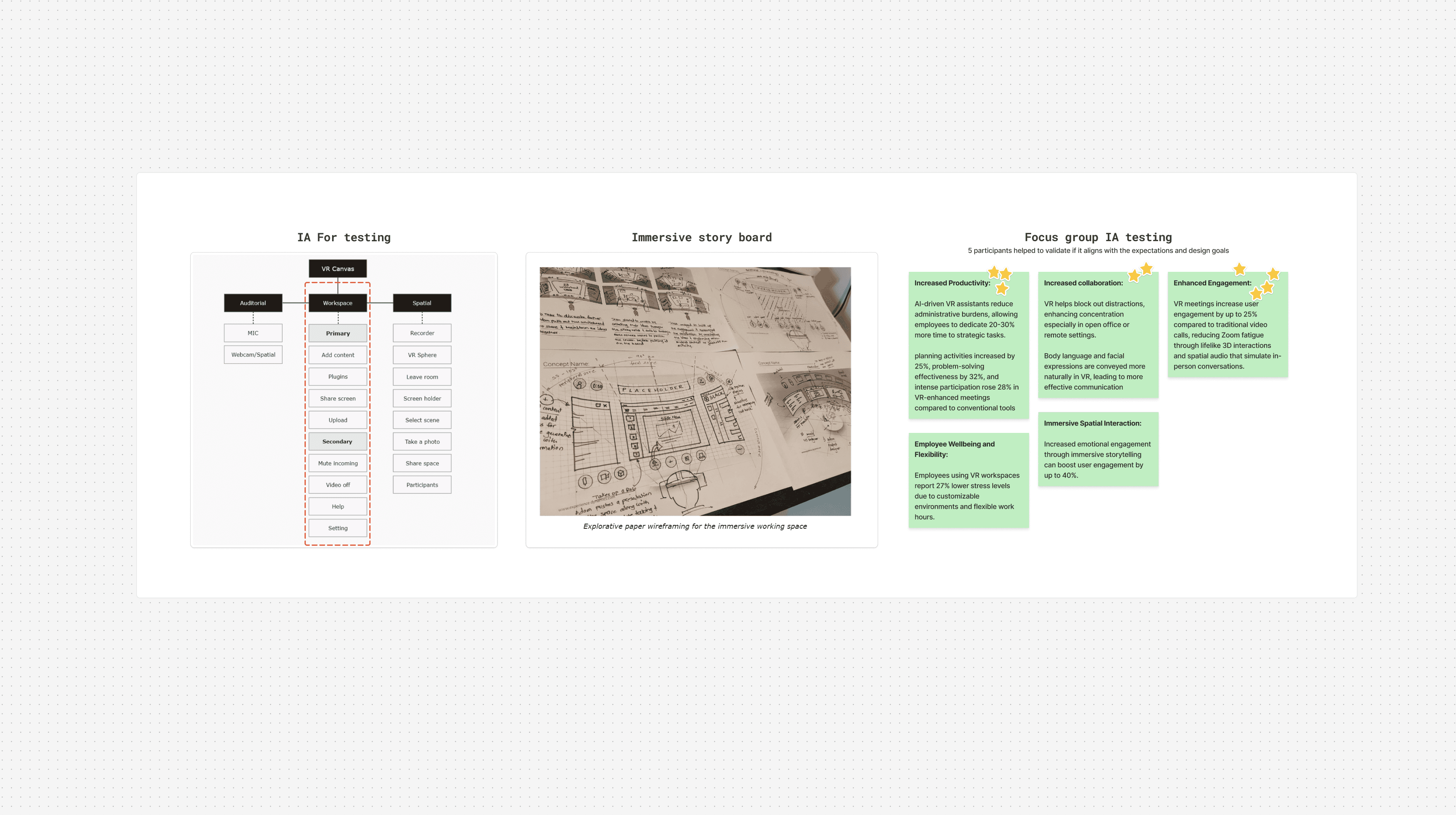
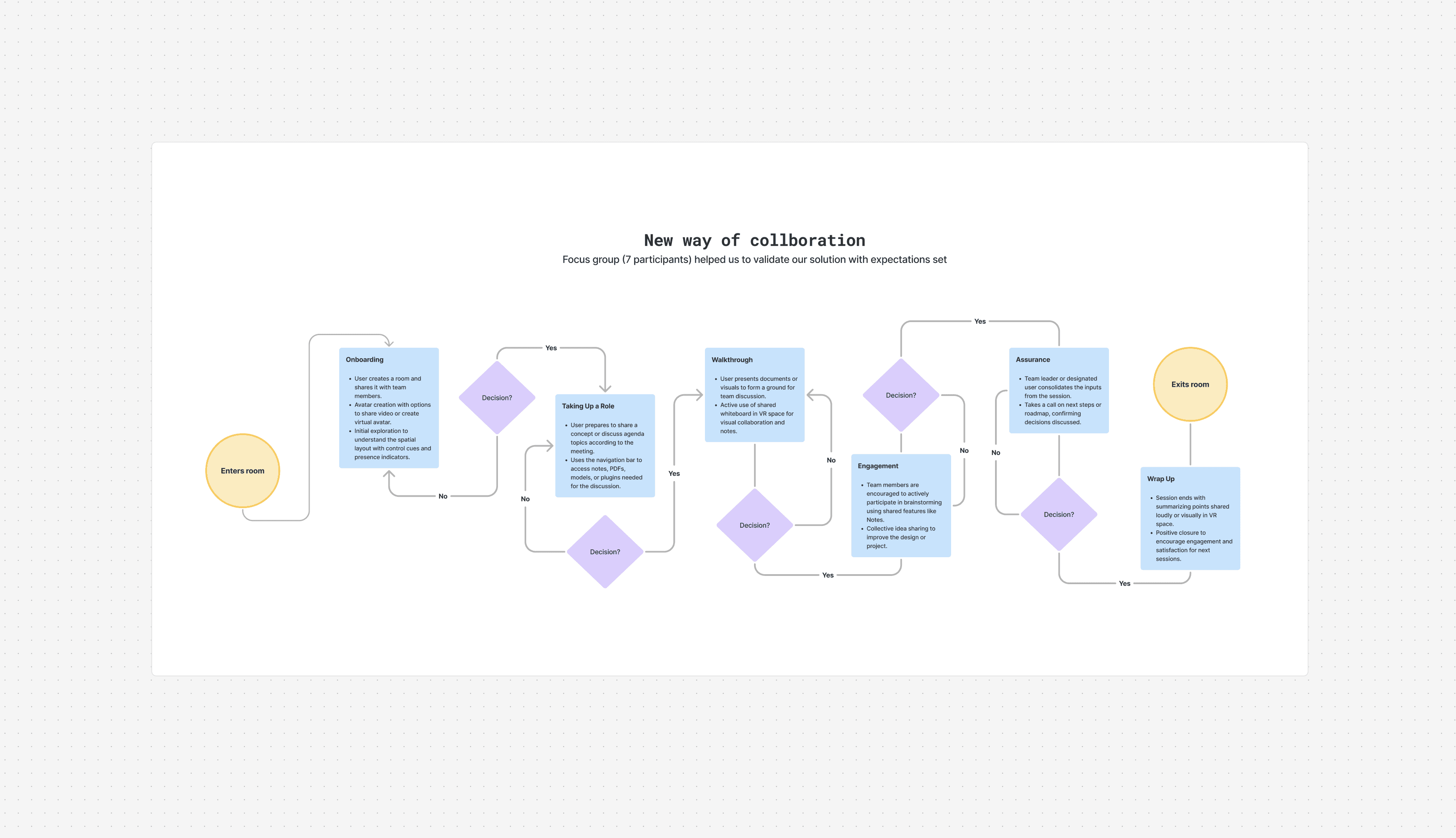
The design centered on spatial clarity and intentional presence translating real-world meeting behaviors such as eye contact, orientation, and shared focus into virtual interaction patterns.
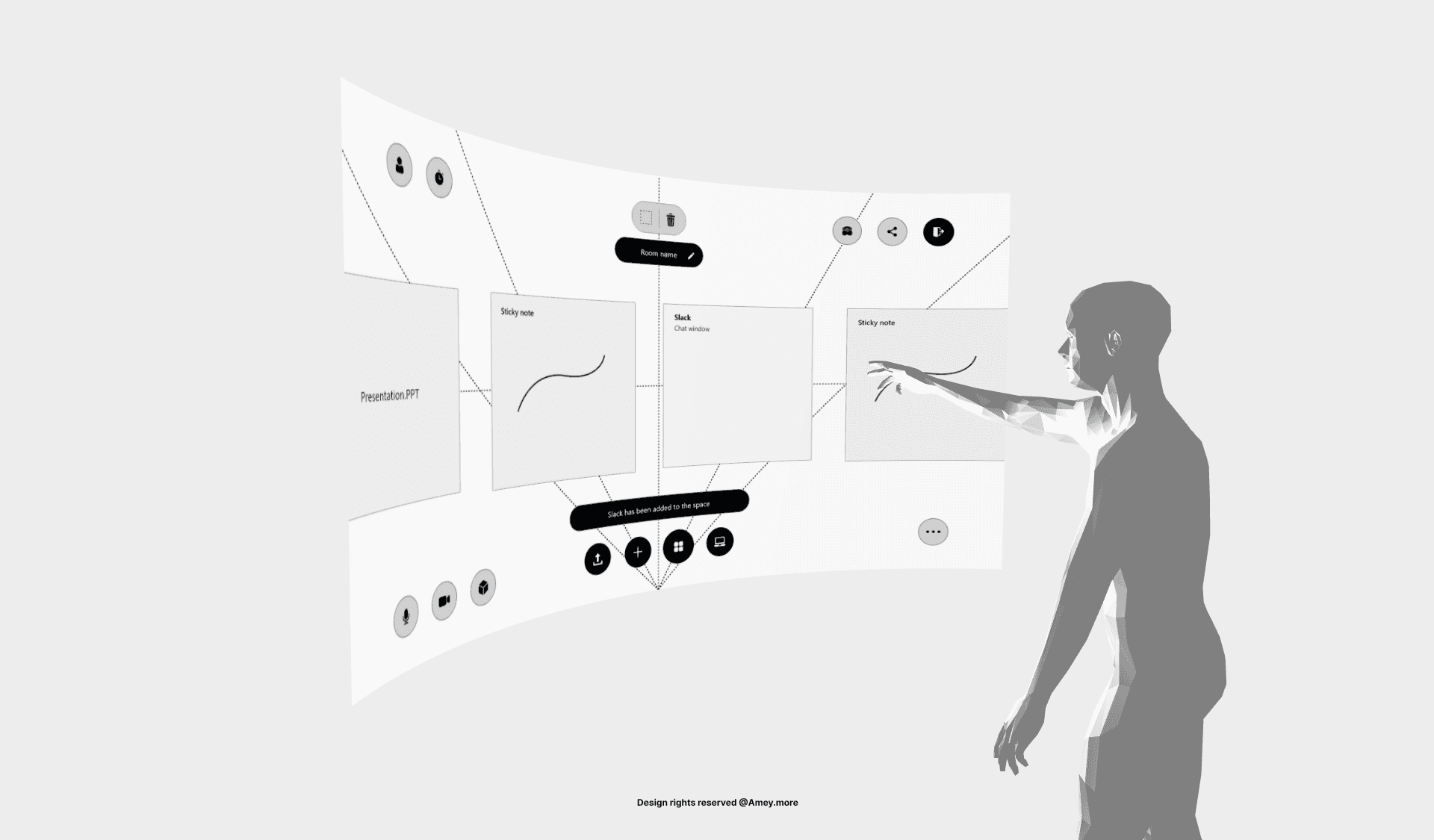
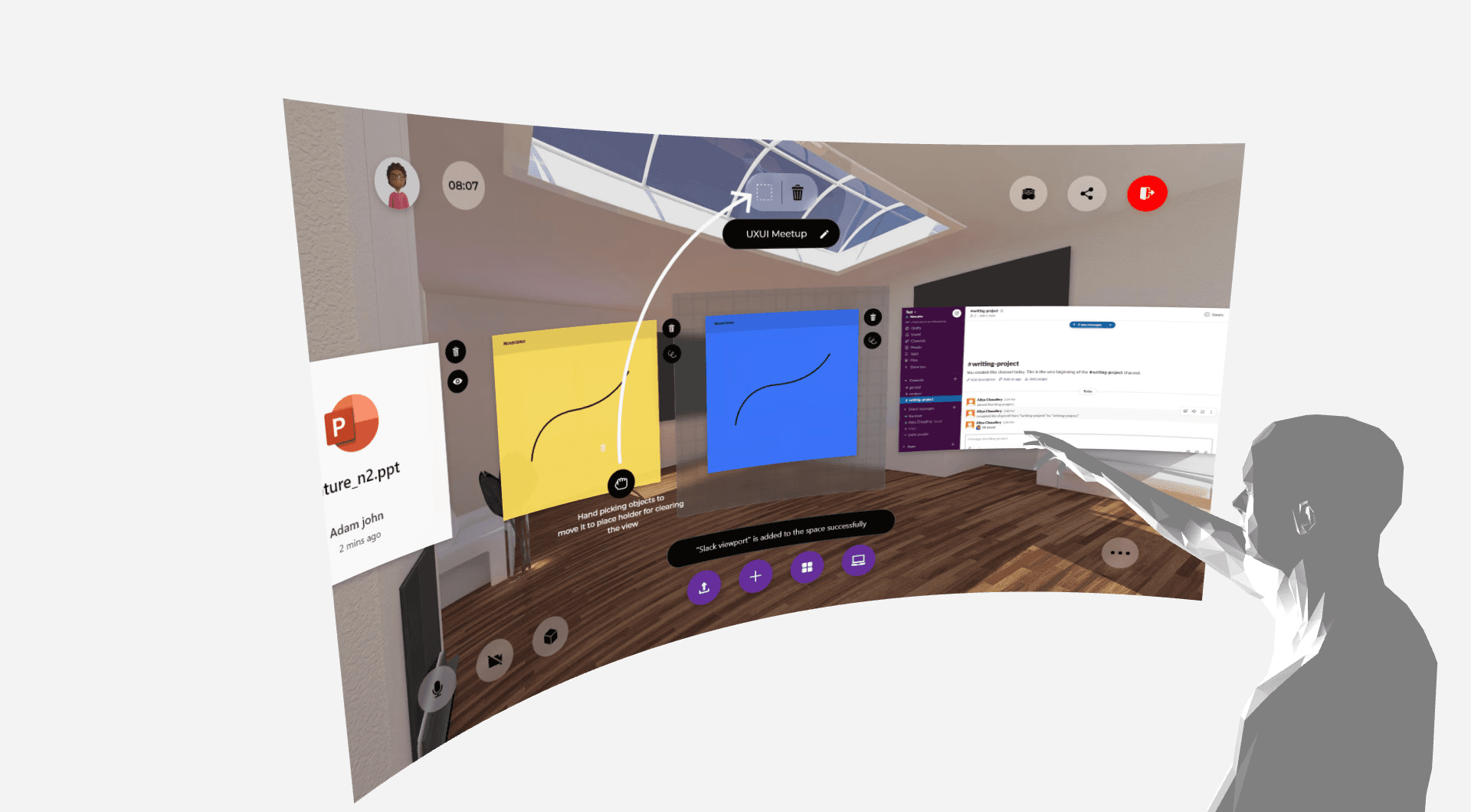
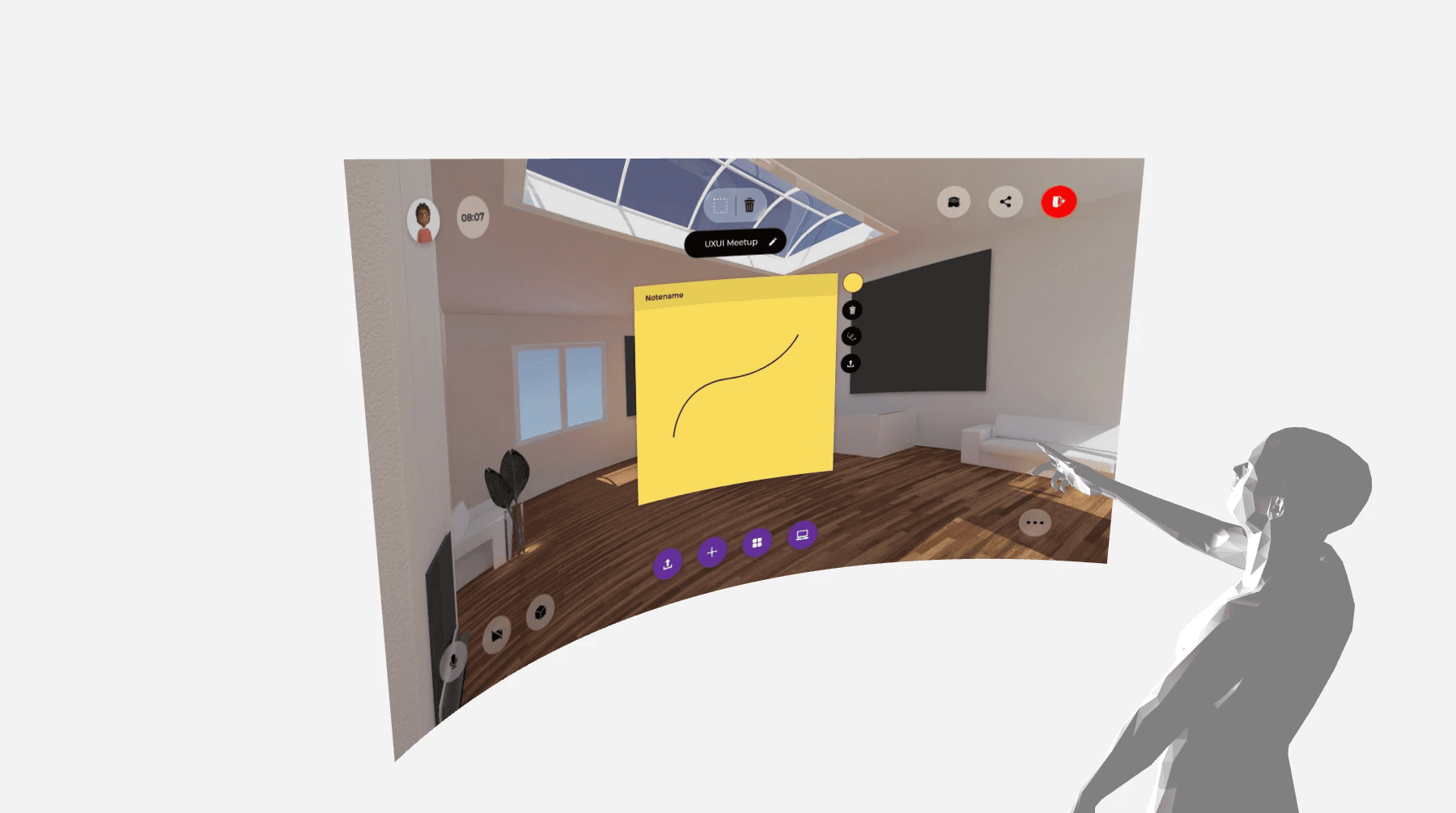
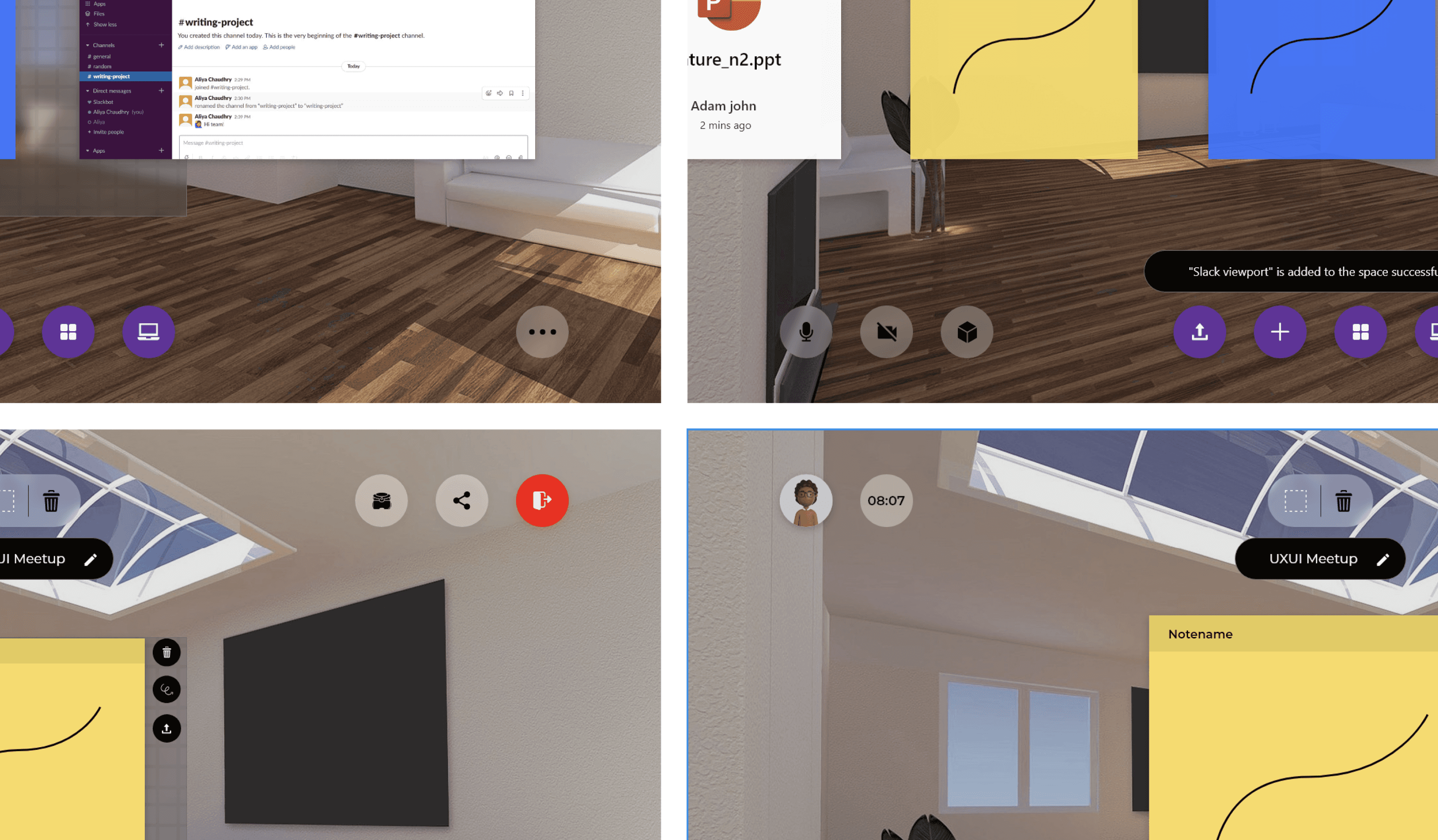
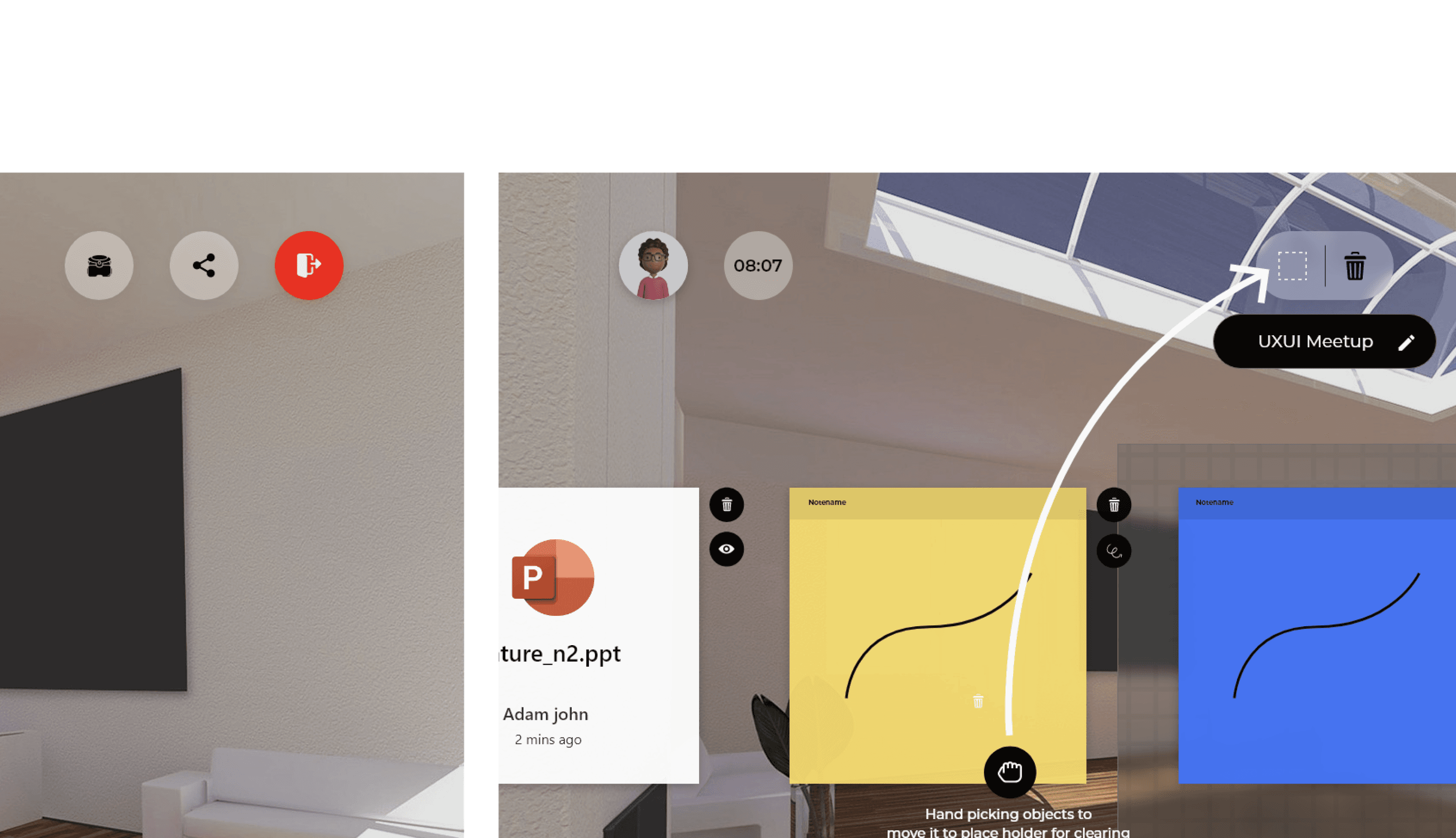
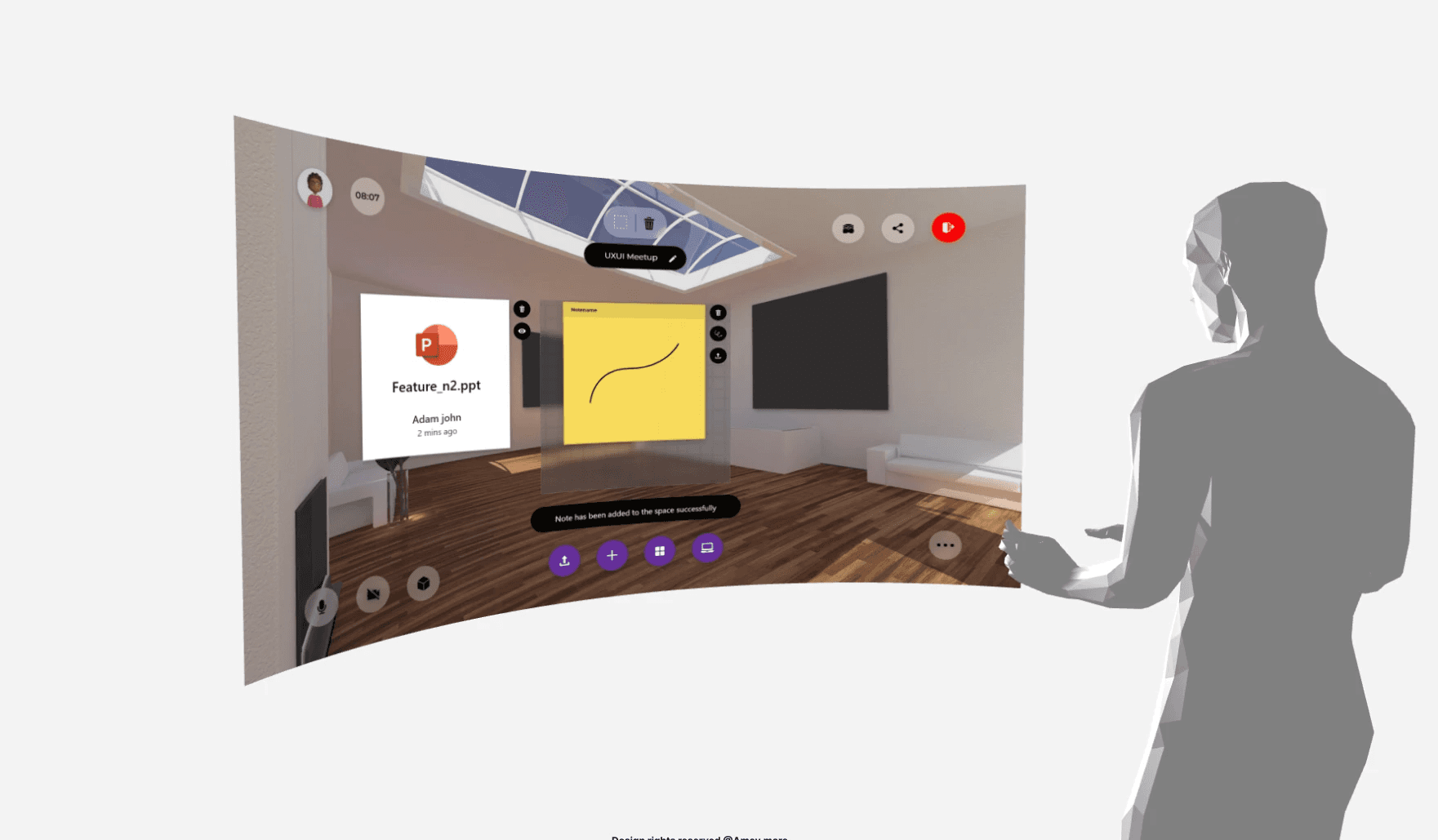
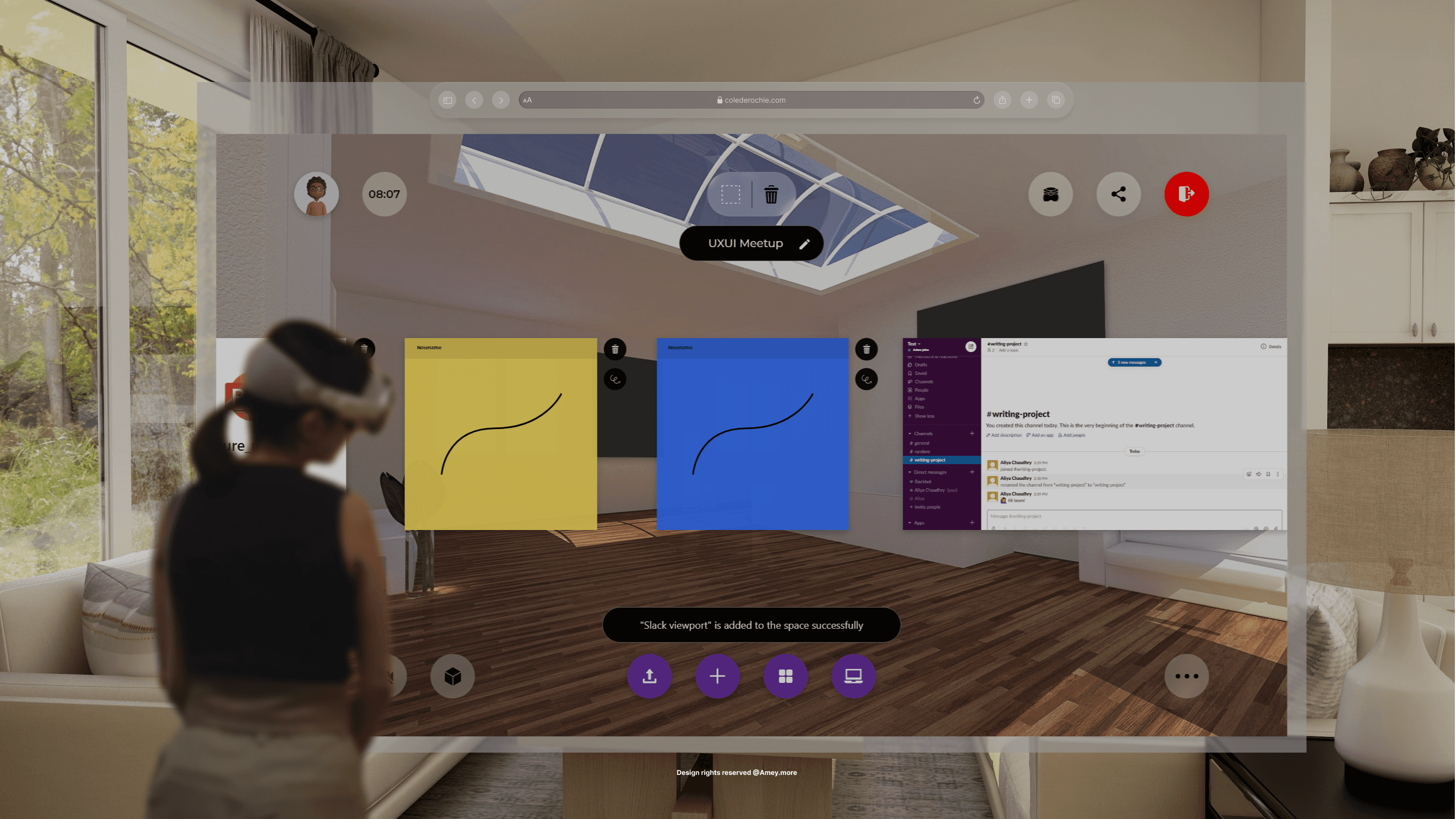
Modular spatial panels for tasks, files, and conversations allowed teams to position information around them rather than navigate nested menus. Visual hierarchy, spatial audio, avatar proximity, and lightweight gestures guided attention without overwhelming the environment.
Usability testing prioritized motion comfort, discoverability, and natural interaction ensuring the experience felt productive, not game-like.
Ideate, Test & Measure
Pilot testing showed encouraging signals
Pilot testing showed encouraging signals
The results suggested that spatial coherence not novelty drove measurable gains in alignment and efficiency.
23% reduction in context switching for product managers, 2× faster collaboration on 3D artifacts for designers, 64% reduction in validation rework for engineering teams

This project reinforced that immersive design succeeds only when it respects human limits. Presence, clarity, and comfort matter more than visual novelty.
This project reinforced that immersive design succeeds only when it respects human limits. Presence, clarity, and comfort matter more than visual novelty.
Future iterations could personalize spatial layouts by role, introduce adaptive comfort settings for extended sessions, and expand workflows into training, onboarding, and cross-functional planning.
With the right constraints, immersive collaboration has the potential to evolve from meeting replacement to everyday work infrastructure.
Impact
20–30% (Low context switch)
Impact
20–30% (Low context switch)
Impact
30 (Mins stable attention)
Impact
30 (Mins stable attention)
Impact
30–50% (Reduced work)
Impact
30–50% (Reduced work)
Impact
<15% (Reduced task drop-off)
Impact
<15% (Reduced task drop-off)
Continue Reading...

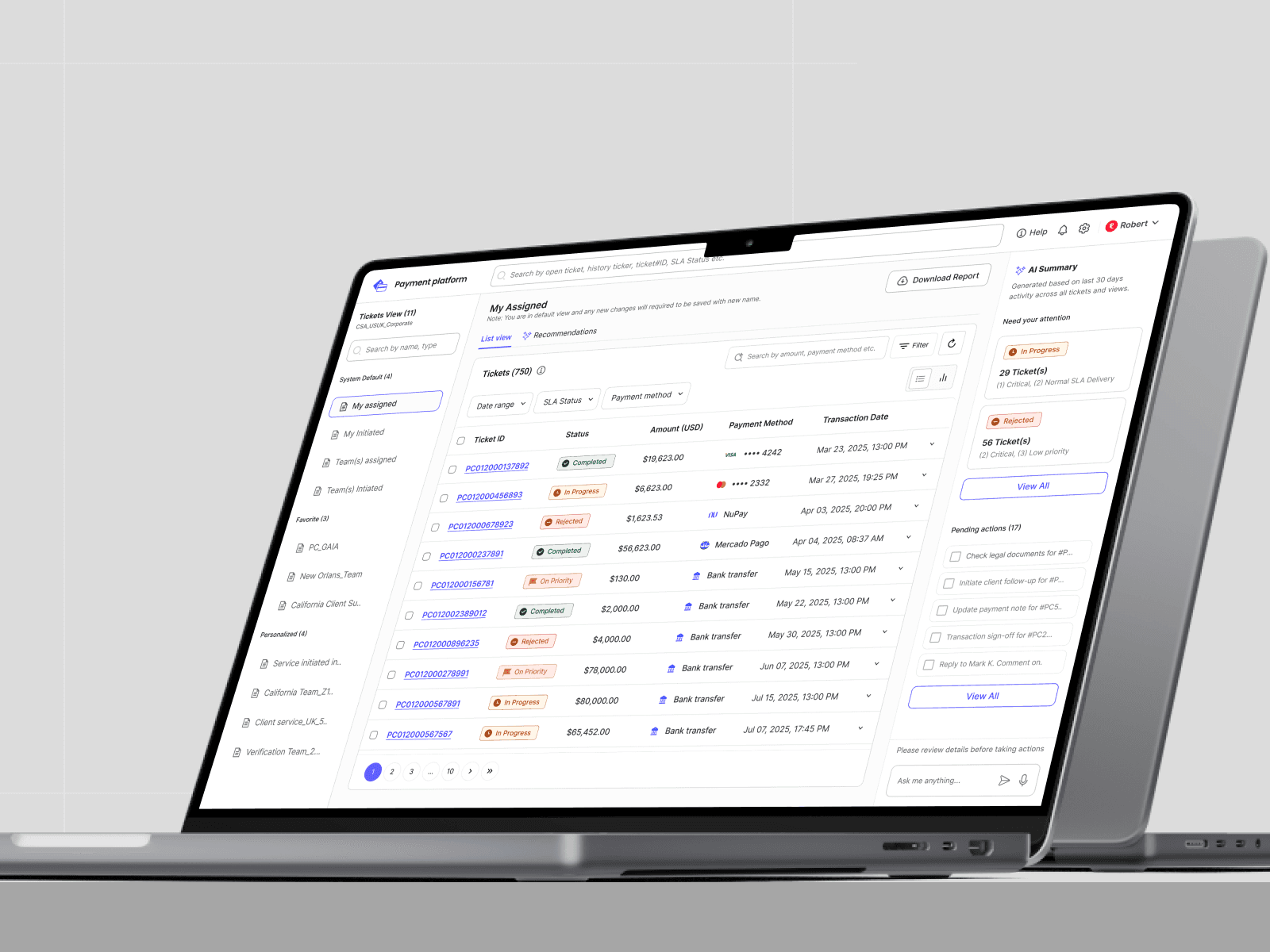
Spatial Collaboration Workspace
Built an immersive VR workspace that reduced context switching by 23%, doubled artifact review speed, and cut validation rework by 64%.
Spatial Collaboration Workspace
Built an immersive VR workspace that reduced context switching by 23%, doubled artifact review speed, and cut validation rework by 64%.
Spatial Collaboration Workspace
Built an immersive VR workspace that reduced context switching by 23%, doubled artifact review speed, and cut validation rework by 64%.
Status & Year
Development (2025-26)
Status
Development (2025-26)
Status & Year
Development (2025-26)
Company
Spatial.io
Company
Spatial.io
Disclaimer
This project is based on real-world experience in a immersive space. Sensitive data, system identifiers, and workflows been modified to maintain confidentiality.
Problem Statement & Challenges
Remote teams rely on fragmented collaboration stacks video calls, whiteboards, task trackers, and chat resulting in constant context switching and cognitive fatigue. The collaboration layer feels distributed rather than shared.
Spatial IO explores how virtual reality can reintroduce a persistent shared workspace one that unifies communication, co-creation, and task management in an environment that feels closer to working side by side.
My Contribution
I led the end-to-end UX design for Spatial IO, mapping collaboration journeys and defining spatial interaction models for immersive teamwork.
My work spanned research synthesis, spatial layout architecture, modular interface systems, and high-fidelity VR prototyping partnering closely with Product and Engineering to bring the experience from concept to handoff.
Design
1 Member
Design
1 Member
Product
1 Member
Product
1 Member
Engg+Data+Ops
1 Member
Engg+Data+Ops
1 Member
Timeline
2 Sprints
Timeline
2 Sprints
Persona, Jobs to be done
Focus group sessions with product managers, designers, and engineers revealed shared collaboration friction across roles.
Product managers struggled to maintain visibility across fragmented tools. Designers lacked a shared spatial canvas for co-creation and critique. Engineers faced rework driven by misalignment and unclear validation during reviews.
Quantitative signals reinforced this pattern: 71% reported losing time to screen switching, 78% experienced video fatigue, and 62% lost focus in meetings lacking spatial or visual cues.
Extended headset use further introduced physical discomfort during longer sessions.
Our North Star
Create a unified, immersive workspace that eliminates tool switching, supports both synchronous and asynchronous collaboration, and mirrors the natural flow of in-person teamwork without increasing cognitive or physical strain.
Field interaction
15 (Focus group users)
Research
15 (Focus group users)
Field interaction
15 (Focus group users)
System logs
~330 Millions (Remote workers)
System logs
~330 Millions (Remote workers)
Sample
75% (Mentally stressed)
Sample
75% (Mentally stressed)
Mapping & Analysis
5 Days (Mapping & analysis)
Mapping & Analysis
5 Days (Mapping & analysis)
The design centered on spatial clarity and intentional presence translating real-world meeting behaviors such as eye contact, orientation, and shared focus into virtual interaction patterns.
Modular spatial panels for tasks, files, and conversations allowed teams to position information around them rather than navigate nested menus. Visual hierarchy, spatial audio, avatar proximity, and lightweight gestures guided attention without overwhelming the environment.
Usability testing prioritized motion comfort, discoverability, and natural interaction ensuring the experience felt productive, not game-like.
Ideate, Test & Measure
Pilot testing showed encouraging signals
Pilot testing showed encouraging signals
The results suggested that spatial coherence not novelty drove measurable gains in alignment and efficiency.
23% reduction in context switching for product managers, 2× faster collaboration on 3D artifacts for designers, 64% reduction in validation rework for engineering teams
This project reinforced that immersive design succeeds only when it respects human limits. Presence, clarity, and comfort matter more than visual novelty.
This project reinforced that immersive design succeeds only when it respects human limits. Presence, clarity, and comfort matter more than visual novelty.
Future iterations could personalize spatial layouts by role, introduce adaptive comfort settings for extended sessions, and expand workflows into training, onboarding, and cross-functional planning.
With the right constraints, immersive collaboration has the potential to evolve from meeting replacement to everyday work infrastructure.
Impact
20–30% (Low context switch)
Impact
20–30% (Low context switch)
Impact
30 (Mins stable attention)
Impact
30 (Mins stable attention)
Impact
30–50% (Reduced work)
Impact
30–50% (Reduced work)
Impact
<15% (Reduced task drop-off)
Impact