
Nykaa Fashion: AI Styling Assistant
Confidence-first AI experience reduced decision anxiety, driving a projected 12-percentage-point Add-to-Bag lift, ₹720 incremental RPU per user, and unlocking 60% of the identified revenue opportunity.
Nykaa Fashion: AI Styling Assistant
Confidence-first AI experience reduced decision anxiety, driving a projected 12-percentage-point Add-to-Bag lift, ₹720 incremental RPU per user, and unlocking 60% of the identified revenue opportunity.
Nykaa Fashion: AI Styling Assistant
Confidence-first AI experience reduced decision anxiety, driving a projected 12-percentage-point Add-to-Bag lift, ₹720 incremental RPU per user, and unlocking 60% of the identified revenue opportunity.
Status & Year
Thesis (2026-27)
Status
Thesis (2026-27)
Status & Year
Thesis (2026-27)
Company
Nykaa Fashion
Company
Nykaa Fashion
Disclaimer
This project is based on a two-week intensive design capstone completed as part of an AI Product Management cohort. Research synthesis, preference testing, and business projections are informed by capstone findings and industry benchmarks, not post-launch data. The solution is positioned as a Phase 1 MVP.
Problem Statement & Challenges
Opportunity
Design a confidence-first AI shopping experience that reduces fit anxiety, builds trust across every decision, and helps mobile-first fashion shoppers buy with confidence without relying on intrusive automation.
Business Context
Nykaa Fashion serves 6–10M monthly active users, with 60–70% being highly engaged but not converting. The focus was on inspiration-led, assurance-seeking shoppers (20–45 years) who spent 5–10 minutes on product pages yet hesitated to purchase.
These users compared 15–20 products per session, piecing together confidence from photos, reviews, and size guides often leaving without a clear buying decision.
Problem
Shoppers dropped off at the moment of purchase due to fit uncertainty, limited social proof, and decision overload. Constant switching between reviews, size guides, and product details led to 55–60% cart abandonment after Add-to-Bag and 35% size-related returns.
Challenge
Create a confidence-first AI system that guides shoppers from Browse - Evaluate - Commit - Confirm, delivering personalized, trustworthy recommendations while avoiding over-automation.
The solution also had to be mobile-first, privacy-compliant, and aligned with Nykaa Fashion's brand experience.
My Contribution
Led end-to-end product design from problem framing and research synthesis to persona definition, rapid prototyping, validation, and 12-month roadmap planning.
Synthesized insights from 25+ user surveys and confidence-gap analysis, defined six AI design principles, mapped confidence needs across the end-to-end shopping journey, and delivered a phased rollout strategy with a clearly scoped Phase 1 MVP.
Design
1 Member
Design
1 Member
Product
1 Member
Product
1 Member
Engg+Data+Ops
1 Member
Engg+Data+Ops
1 Member
Timeline
2 Weeks
Timeline
2 Weeks


Persona, Jobs to be done
Research combined 25+ user surveys, analysis of 150 shopping behavior patterns, competitive benchmarking across Flipkart, Amazon, and Instagram Shopping, and preference testing with eight participants using interactive Figma prototypes.
Primary Users
Style-conscious shoppers (20–45 years) across Tier 1–2 cities with strong purchase intent but low confidence.
They spent significant time on product pages, comparing sizing, reviews, and images before abandoning purchases due to fit uncertainty and fear of making the wrong choice.
Secondary Users
Repeated buyers who Look for faster, personalized shopping experiences based on previous experience, buying habits.
Prioritization
The MVP focused on solving the confidence gap validating fit before purchase and building trust progressively across the shopping journey. AI was designed to guide decisions, not make them, with transparency and user control embedded into every interaction.
Higher-effort capabilities such as style personalization, complete-the-look recommendations, and AR try-on were intentionally deferred to later phases, as fit uncertainty represented the largest barrier to conversion.
Key Constraints
Model Confidence: Surface personalized recommendations only above an 85% confidence threshold; otherwise provide generic guidance.
Data Quality: Accurate fit recommendations depend on rich product attributes, sizing, and catalog consistency.
Privacy: Explicit opt-in for body measurements and purchase history, aligned with privacy requirements.
Performance: Generate recommendations in under 500ms across typical mobile networks.
Explainability: Every recommendation clearly explains why it was made (e.g., size, brand fit, and similar shopper data) to build trust and avoid algorithmic uncertainty.
Our North Star
User Needs
Users needed clear fit confidence, trusted social proof, and faster decision-making without jumping between reviews, size guides, and product details.
They wanted AI to feel like a trusted shopping companion offering guidance and reassurance, not pushing purchases.
Goal
Design a confidence-first AI experience that validates fit early, builds trust throughout the shopping journey, and explains recommendations transparently.
By reducing fit uncertainty and decision friction, the goal was to help shoppers make faster, more confident purchase decisions while improving conversion and reducing post-purchase regret.
Field interaction
25+ Interviewed
Research
25+ Interviewed
Field interaction
25+ Interviewed
System logs
1 (India)
System logs
1 (India)
Sample
4+ (Metro cities)
Sample
4+ (Metro cities)
Mapping & Analysis
3 Days
Mapping & Analysis
3 Days


The experience prioritized confidence, simplicity, and transparency by progressively surfacing fit, quality, social proof, and affirmation when users needed them most, reducing decision anxiety without adding cognitive load.
Design Solution
The experience was shaped around three personas: Aarohi, Neha, and Ritika, each representing a different confidence barrier. The solution introduced targeted interventions across the Browse - Evaluate -Commit - Confirm journey to progressively build trust.
Fit Confidence Badge (Browse)
An 85% Fit badge with intuitive color coding surfaced directly on product cards, helping users assess fit before opening the PDP.
Impact: 92% confidence perception accuracy.
Real-Body Gallery (Evaluate)
A carousel of real customers across different body types and sizes, with body-type filters placed prominently on the PDP.
Impact: 3× higher engagement than studio imagery and +15% gallery interaction.
AI Styling Assistant (Evaluate)
A conversational AI guide that recommends outfits through a multi-turn interaction, offering personalized styling without aggressive upselling.
Impact: 7 of 8 participants engaged with the assistant, generating 3× higher engagement than static recommendation cards.
Complete-the-Look Bundles (Commit)
Contextual outfit recommendations with transparent bundle savings, presented in a supportive, non-FOMO tone.
Impact: 85% add-to-bundle preference with stronger long-term retention intent.
Soft Affirmation (Confirm)
A subtle confirmation message reinforced purchase confidence using fit validation, peer signals, easy returns, and delivery information.
Impact: Reduced purchase regret and projected 50% higher repeat purchase intent than urgency-driven messaging.
Validation
8 participants, 40+ interactive Figma screens. AI Style assistant workflow.
Rapid preference testing validated the confidence-first approach across messaging, interaction patterns, transparency, and mobile usability.
Fit confidence badges: 92% confidence perception vs. 60% for neutral indicators.
Real-body imagery: 3× higher engagement than below-the-fold placement.
Inline AI assistant: Preferred by 7/8 participants over a separate CTA.
Soft bundle messaging: 85% bundle preference with lower purchase regret (8% vs. 18% for FOMO messaging).
Persistent confidence indicators: Users valued seeing fit confidence throughout the journey, reducing decision anxiety from discovery to checkout.
Ideate, Test & Measure

Over a two-week sprint, eight design variations were rapidly iterated and evaluated using a FigJam research board, real-time user feedback synthesis, and preference testing across interaction patterns, content, placement, tone, and mobile UX
Over a two-week sprint, eight design variations were rapidly iterated and evaluated using a FigJam research board, real-time user feedback synthesis, and preference testing across interaction patterns, content, placement, tone, and mobile UX
Rapid Iteration
Over Days 5–7, the solution evolved through rapid design sprints focused on five core experience components.
Using a FigJam research board, eight design variations were evaluated against information architecture, design system consistency, and user feedback to refine the confidence-first experience before prototyping.
Projected Impact
The confidence-first AI system is projected to improve conversion, customer confidence, and long-term retention while reducing purchase regret, size-related returns, and decision friction over a 12-month rollout.
Innovation Opportunities
The solution also identified opportunities for future intellectual property:
Fit Confidence Engine: Body-type cohort learning that combines user profiles, brand sizing, and historical fit signals to generate explainable fit confidence.
Real-Body Validation System: Intelligent collection, matching, and ranking of real-user photos by body type and garment fit.
Confidence Architecture: A progressive trust framework using transparent explanations and soft affirmation instead of urgency-based persuasion.
Conversational Styling Intelligence: AI-powered outfit recommendations that combine conversational guidance with contextual bundle creation.


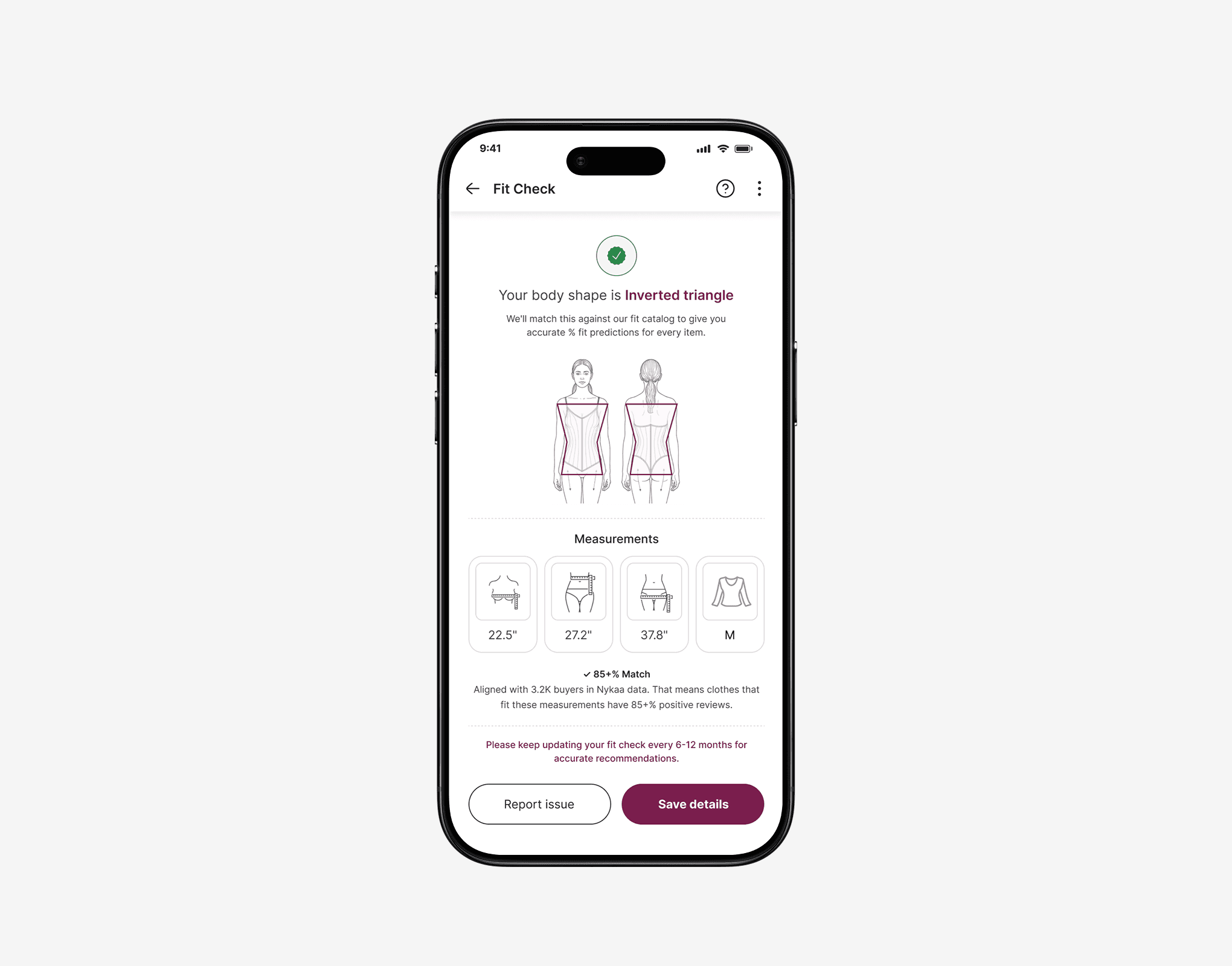


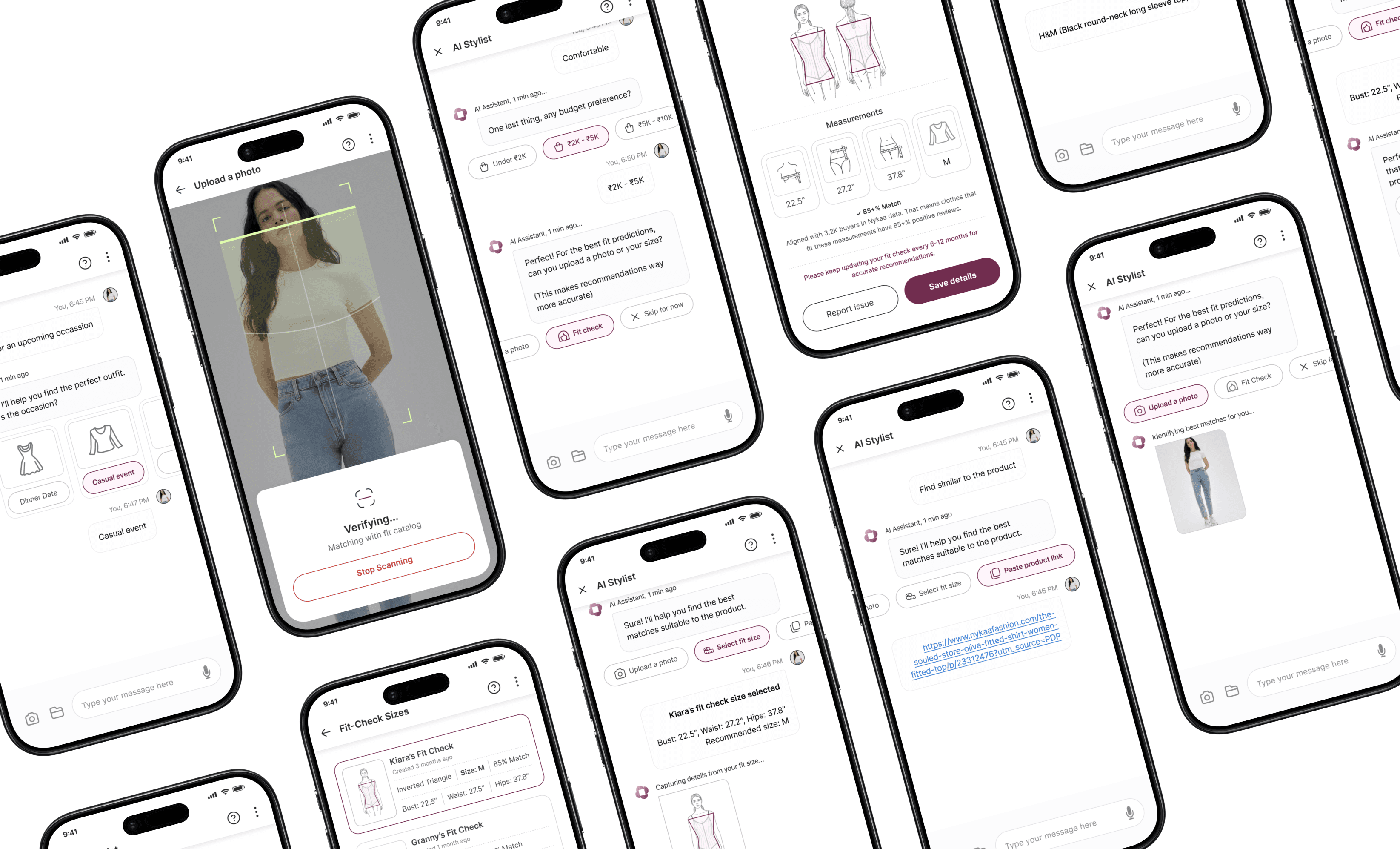

The solution tackled fit anxiety the biggest barrier for 65–70% of shoppers through transparent AI guidance that built trust and confidence at every stage of the journey.
The solution tackled fit anxiety the biggest barrier for 65–70% of shoppers through transparent AI guidance that built trust and confidence at every stage of the journey.
12-Month Roadmap
The roadmap expands the confidence-first foundation in phases, increasing personalization as user trust grows.
Q3–Q4: Fit Confidence Expansion
Extend Fit Confidence beyond apparel to footwear and accessories, adapting the model to categories where purchase confidence remains a key barrier.
Q4–Q1: AR Try-On
Introduce AR-powered try-on to combine visual validation with Fit Confidence, helping shoppers see how products look in real-world contexts before purchasing.
Q2–Q3: Personal Stylist AI
Evolve from fit guidance to personalized styling, using preference learning and style clustering to recommend outfits tailored to each shopper.
Impact
32% (+12 pp) ATB Conversion
Impact
32% (+12 pp) ATB Conversion
Impact
₹1,920 (+60%) RPU
Impact
₹1,920 (+60%) RPU
Impact
2.0+ items/ Basket depth
Impact
2.0+ items/ Basket depth
Impact
5-7 min (Browse-to-purchase)
Impact
5-7 min (Browse-to-purchase)
Explore Projects


Nykaa Fashion: AI Styling Assistant
Confidence-first AI experience reduced decision anxiety, driving a projected 12-percentage-point Add-to-Bag lift, ₹720 incremental RPU per user, and unlocking 60% of the identified revenue opportunity.
Nykaa Fashion: AI Styling Assistant
Confidence-first AI experience reduced decision anxiety, driving a projected 12-percentage-point Add-to-Bag lift, ₹720 incremental RPU per user, and unlocking 60% of the identified revenue opportunity.
Nykaa Fashion: AI Styling Assistant
Confidence-first AI experience reduced decision anxiety, driving a projected 12-percentage-point Add-to-Bag lift, ₹720 incremental RPU per user, and unlocking 60% of the identified revenue opportunity.
Status & Year
Thesis (2026-27)
Status
Thesis (2026-27)
Status & Year
Thesis (2026-27)
Company
Nykaa Fashion
Company
Nykaa Fashion
Disclaimer
This project is based on a two-week intensive design capstone completed as part of an AI Product Management cohort. Research synthesis, preference testing, and business projections are informed by capstone findings and industry benchmarks, not post-launch data. The solution is positioned as a Phase 1 MVP.
Problem Statement & Challenges
Opportunity
Design a confidence-first AI shopping experience that reduces fit anxiety, builds trust across every decision, and helps mobile-first fashion shoppers buy with confidence without relying on intrusive automation.
Business Context
Nykaa Fashion serves 6–10M monthly active users, with 60–70% being highly engaged but not converting. The focus was on inspiration-led, assurance-seeking shoppers (20–45 years) who spent 5–10 minutes on product pages yet hesitated to purchase.
These users compared 15–20 products per session, piecing together confidence from photos, reviews, and size guides often leaving without a clear buying decision.
Problem
Shoppers dropped off at the moment of purchase due to fit uncertainty, limited social proof, and decision overload. Constant switching between reviews, size guides, and product details led to 55–60% cart abandonment after Add-to-Bag and 35% size-related returns.
Challenge
Create a confidence-first AI system that guides shoppers from Browse - Evaluate - Commit - Confirm, delivering personalized, trustworthy recommendations while avoiding over-automation.
The solution also had to be mobile-first, privacy-compliant, and aligned with Nykaa Fashion's brand experience.
My Contribution
Led end-to-end product design from problem framing and research synthesis to persona definition, rapid prototyping, validation, and 12-month roadmap planning.
Synthesized insights from 25+ user surveys and confidence-gap analysis, defined six AI design principles, mapped confidence needs across the end-to-end shopping journey, and delivered a phased rollout strategy with a clearly scoped Phase 1 MVP.
Design
1 Member
Design
1 Member
Product
1 Member
Product
1 Member
Engg+Data+Ops
1 Member
Engg+Data+Ops
1 Member
Timeline
2 Weeks
Timeline
2 Weeks
Persona, Jobs to be done
Research combined 25+ user surveys, analysis of 150 shopping behavior patterns, competitive benchmarking across Flipkart, Amazon, and Instagram Shopping, and preference testing with eight participants using interactive Figma prototypes.
Primary Users
Style-conscious shoppers (20–45 years) across Tier 1–2 cities with strong purchase intent but low confidence.
They spent significant time on product pages, comparing sizing, reviews, and images before abandoning purchases due to fit uncertainty and fear of making the wrong choice.
Secondary Users
Repeated buyers who Look for faster, personalized shopping experiences based on previous experience, buying habits.
Prioritization
The MVP focused on solving the confidence gap validating fit before purchase and building trust progressively across the shopping journey. AI was designed to guide decisions, not make them, with transparency and user control embedded into every interaction.
Higher-effort capabilities such as style personalization, complete-the-look recommendations, and AR try-on were intentionally deferred to later phases, as fit uncertainty represented the largest barrier to conversion.
Key Constraints
Model Confidence: Surface personalized recommendations only above an 85% confidence threshold; otherwise provide generic guidance.
Data Quality: Accurate fit recommendations depend on rich product attributes, sizing, and catalog consistency.
Privacy: Explicit opt-in for body measurements and purchase history, aligned with privacy requirements.
Performance: Generate recommendations in under 500ms across typical mobile networks.
Explainability: Every recommendation clearly explains why it was made (e.g., size, brand fit, and similar shopper data) to build trust and avoid algorithmic uncertainty.
Our North Star
User Needs
Users needed clear fit confidence, trusted social proof, and faster decision-making without jumping between reviews, size guides, and product details.
They wanted AI to feel like a trusted shopping companion offering guidance and reassurance, not pushing purchases.
Goal
Design a confidence-first AI experience that validates fit early, builds trust throughout the shopping journey, and explains recommendations transparently.
By reducing fit uncertainty and decision friction, the goal was to help shoppers make faster, more confident purchase decisions while improving conversion and reducing post-purchase regret.
Field interaction
25+ Interviewed
Research
25+ Interviewed
Field interaction
25+ Interviewed
System logs
1 (India)
System logs
1 (India)
Sample
4+ (Metro cities)
Sample
4+ (Metro cities)
Mapping & Analysis
3 Days
Mapping & Analysis
3 Days
The experience prioritized confidence, simplicity, and transparency by progressively surfacing fit, quality, social proof, and affirmation when users needed them most, reducing decision anxiety without adding cognitive load.
Design Solution
The experience was shaped around three personas: Aarohi, Neha, and Ritika, each representing a different confidence barrier. The solution introduced targeted interventions across the Browse - Evaluate -Commit - Confirm journey to progressively build trust.
Fit Confidence Badge (Browse)
An 85% Fit badge with intuitive color coding surfaced directly on product cards, helping users assess fit before opening the PDP.
Impact: 92% confidence perception accuracy.
Real-Body Gallery (Evaluate)
A carousel of real customers across different body types and sizes, with body-type filters placed prominently on the PDP.
Impact: 3× higher engagement than studio imagery and +15% gallery interaction.
AI Styling Assistant (Evaluate)
A conversational AI guide that recommends outfits through a multi-turn interaction, offering personalized styling without aggressive upselling.
Impact: 7 of 8 participants engaged with the assistant, generating 3× higher engagement than static recommendation cards.
Complete-the-Look Bundles (Commit)
Contextual outfit recommendations with transparent bundle savings, presented in a supportive, non-FOMO tone.
Impact: 85% add-to-bundle preference with stronger long-term retention intent.
Soft Affirmation (Confirm)
A subtle confirmation message reinforced purchase confidence using fit validation, peer signals, easy returns, and delivery information.
Impact: Reduced purchase regret and projected 50% higher repeat purchase intent than urgency-driven messaging.
Validation
8 participants, 40+ interactive Figma screens. AI Style assistant workflow.
Rapid preference testing validated the confidence-first approach across messaging, interaction patterns, transparency, and mobile usability.
Fit confidence badges: 92% confidence perception vs. 60% for neutral indicators.
Real-body imagery: 3× higher engagement than below-the-fold placement.
Inline AI assistant: Preferred by 7/8 participants over a separate CTA.
Soft bundle messaging: 85% bundle preference with lower purchase regret (8% vs. 18% for FOMO messaging).
Persistent confidence indicators: Users valued seeing fit confidence throughout the journey, reducing decision anxiety from discovery to checkout.
Ideate, Test & Measure
Over a two-week sprint, eight design variations were rapidly iterated and evaluated using a FigJam research board, real-time user feedback synthesis, and preference testing across interaction patterns, content, placement, tone, and mobile UX
Over a two-week sprint, eight design variations were rapidly iterated and evaluated using a FigJam research board, real-time user feedback synthesis, and preference testing across interaction patterns, content, placement, tone, and mobile UX
Rapid Iteration
Over Days 5–7, the solution evolved through rapid design sprints focused on five core experience components.
Using a FigJam research board, eight design variations were evaluated against information architecture, design system consistency, and user feedback to refine the confidence-first experience before prototyping.
Projected Impact
The confidence-first AI system is projected to improve conversion, customer confidence, and long-term retention while reducing purchase regret, size-related returns, and decision friction over a 12-month rollout.
Innovation Opportunities
The solution also identified opportunities for future intellectual property:
Fit Confidence Engine: Body-type cohort learning that combines user profiles, brand sizing, and historical fit signals to generate explainable fit confidence.
Real-Body Validation System: Intelligent collection, matching, and ranking of real-user photos by body type and garment fit.
Confidence Architecture: A progressive trust framework using transparent explanations and soft affirmation instead of urgency-based persuasion.
Conversational Styling Intelligence: AI-powered outfit recommendations that combine conversational guidance with contextual bundle creation.
The solution tackled fit anxiety the biggest barrier for 65–70% of shoppers through transparent AI guidance that built trust and confidence at every stage of the journey.
The solution tackled fit anxiety the biggest barrier for 65–70% of shoppers through transparent AI guidance that built trust and confidence at every stage of the journey.
12-Month Roadmap
The roadmap expands the confidence-first foundation in phases, increasing personalization as user trust grows.
Q3–Q4: Fit Confidence Expansion
Extend Fit Confidence beyond apparel to footwear and accessories, adapting the model to categories where purchase confidence remains a key barrier.
Q4–Q1: AR Try-On
Introduce AR-powered try-on to combine visual validation with Fit Confidence, helping shoppers see how products look in real-world contexts before purchasing.
Q2–Q3: Personal Stylist AI
Evolve from fit guidance to personalized styling, using preference learning and style clustering to recommend outfits tailored to each shopper.
Impact
32% (+12 pp) ATB Conversion
Impact
32% (+12 pp) ATB Conversion
Impact
₹1,920 (+60%) RPU
Impact
₹1,920 (+60%) RPU
Impact
2.0+ items/ Basket depth
Impact
2.0+ items/ Basket depth
Impact
5-7 min (Browse-to-purchase)
Impact