
AI Powered Payments Platform
Transformed a complex payment blotter into an AI-assisted workspace by cutting task time to <3 minutes, reduced ticket allocation per team <1500.
AI Powered Payments Platform
Transformed a complex payment blotter into an AI-assisted workspace by cutting task time to <3 minutes, reduced ticket allocation per team <1500.
AI Powered Payments Platform
Transformed a complex payment blotter into an AI-assisted workspace by cutting task time to <3 minutes, reduced ticket allocation per team <1500.
Status & Year
Awarded (2025-26)
Status
Awarded (2025-26)
Status & Year
Awarded (2025-26)
Company
JP Morgan
Company
JP Morgan
Disclaimer
This project is based on real-world experience in a regulated enterprise environment. Sensitive data, system identifiers, and workflows have been modified to maintain confidentiality.
Problem Statement & Challenges
JP Morgan’s payment operations teams handled thousands of daily escalations across fragmented workflows, where operational associates relied heavily on manual prioritization and repetitive investigation patterns.
The challenge was to improve operational efficiency and decision-making speed without disrupting legacy enterprise systems or compliance-sensitive workflows.
My Contribution
Led end-to-end product design across discovery, workflow mapping, AI-assisted interactions, prototyping, and validation. Partnered closely with research, product, operations, and engineering teams to define scope, validate workflows, and support implementation.
Design
1 Member
Design
1 Member
Product
2 Member
Product
2 Member
Engg+Data+Ops
3 Member
Engg+Data+Ops
3 Member
Timeline
2 Sprints
Timeline
2 Sprints

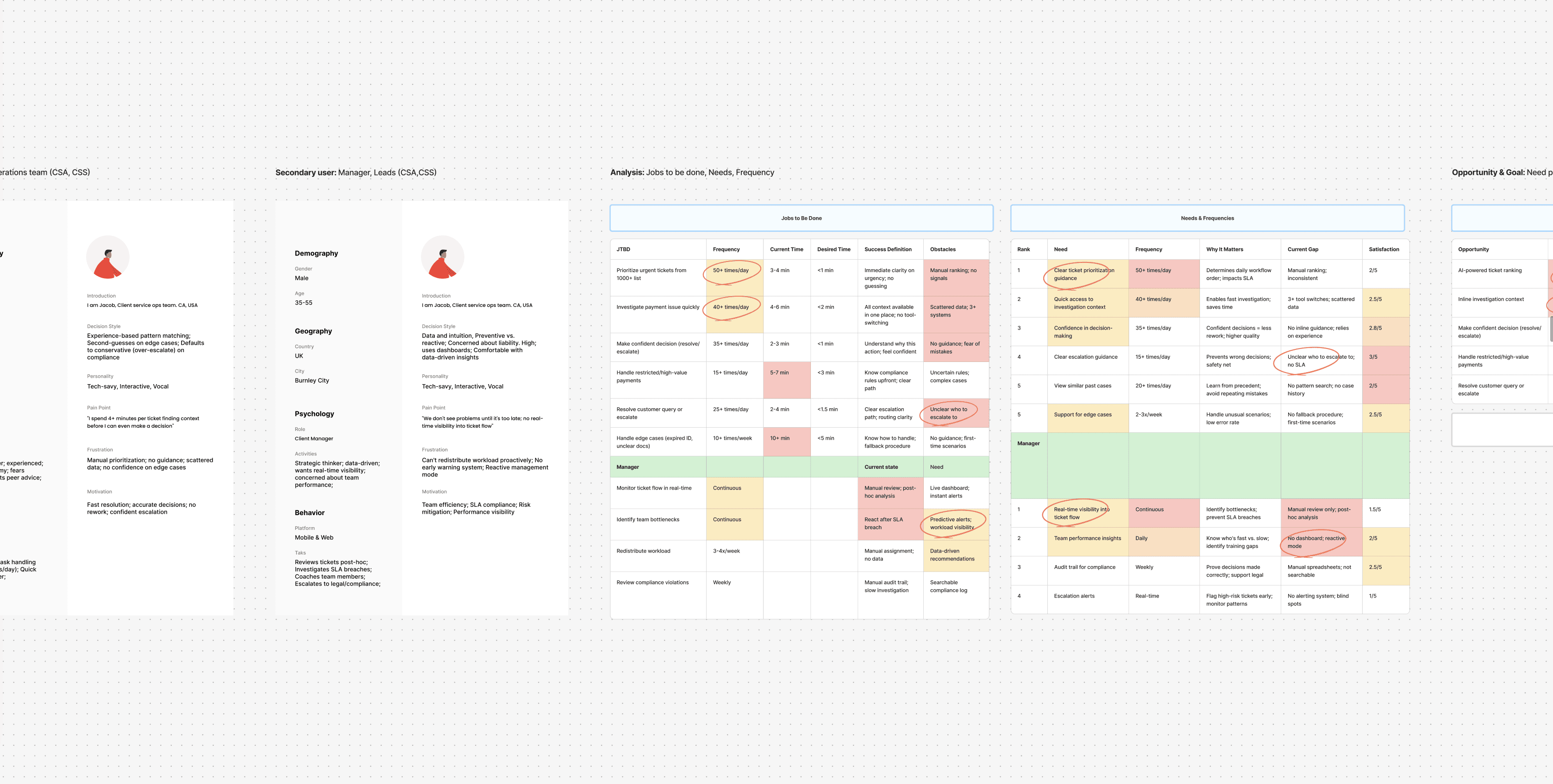
Persona, Jobs to be done
16+ one-on-one interviews, survey with 250+ respondent, 300~ session logs studied & conducted existing product audit.
These roles operate in environments that are high-risk, time-sensitive, and compliance-driven, where even minor ambiguity can delay resolution or escalate risk.
Despite varying responsibilities, a consistent pattern emerged: the system provided data, but not clarity.
Our North Star
To transform the blotter from a dense monitoring interface into a structured operational workspace.
The goal was to reduce cognitive load, improve decision confidence, and preserve enterprise-level depth while making the system feel coherent, not overwhelming.
Field interaction
16 Interviews
Research
16 Interviews
Field interaction
16 Interviews
System logs
300 Sessions
System logs
300 Sessions
Sample
4+ Offices
Sample
4+ Offices
Mapping & Analysis
4 Days
Mapping & Analysis
4 Days


We began by mapping existing user journeys, auditing listing logic, and identifying inconsistency across roles and access layers. Whiteboard sessions uncovered how visibility rules and legacy decisions created fragmentation.
Why AI?
The problem was not lack of operational data it was the inability to surface the right information at the right moment within time-sensitive workflows.
AI was introduced as an operational co-pilot to prioritize actions, surface contextual recommendations, and reduce manual investigation effort without replacing human decision-making.
Ideate, Test & Measure

The new flow organizes payment data through clearer hierarchy and structured states. Role-aware access is surfaced transparently rather than buried in system logic. Ticket handling is embedded directly within contextual views, reducing back-and-forth navigation.
The new flow organizes payment data through clearer hierarchy and structured states. Role-aware access is surfaced transparently rather than buried in system logic. Ticket handling is embedded directly within contextual views, reducing back-and-forth navigation.
Key Trade-offs
Guided operational workflows over open-ended conversations
Workflow familiarity over full-system redesign
AI-assisted prioritization over autonomous decision-making
Lightweight integration over large-scale platform replacement


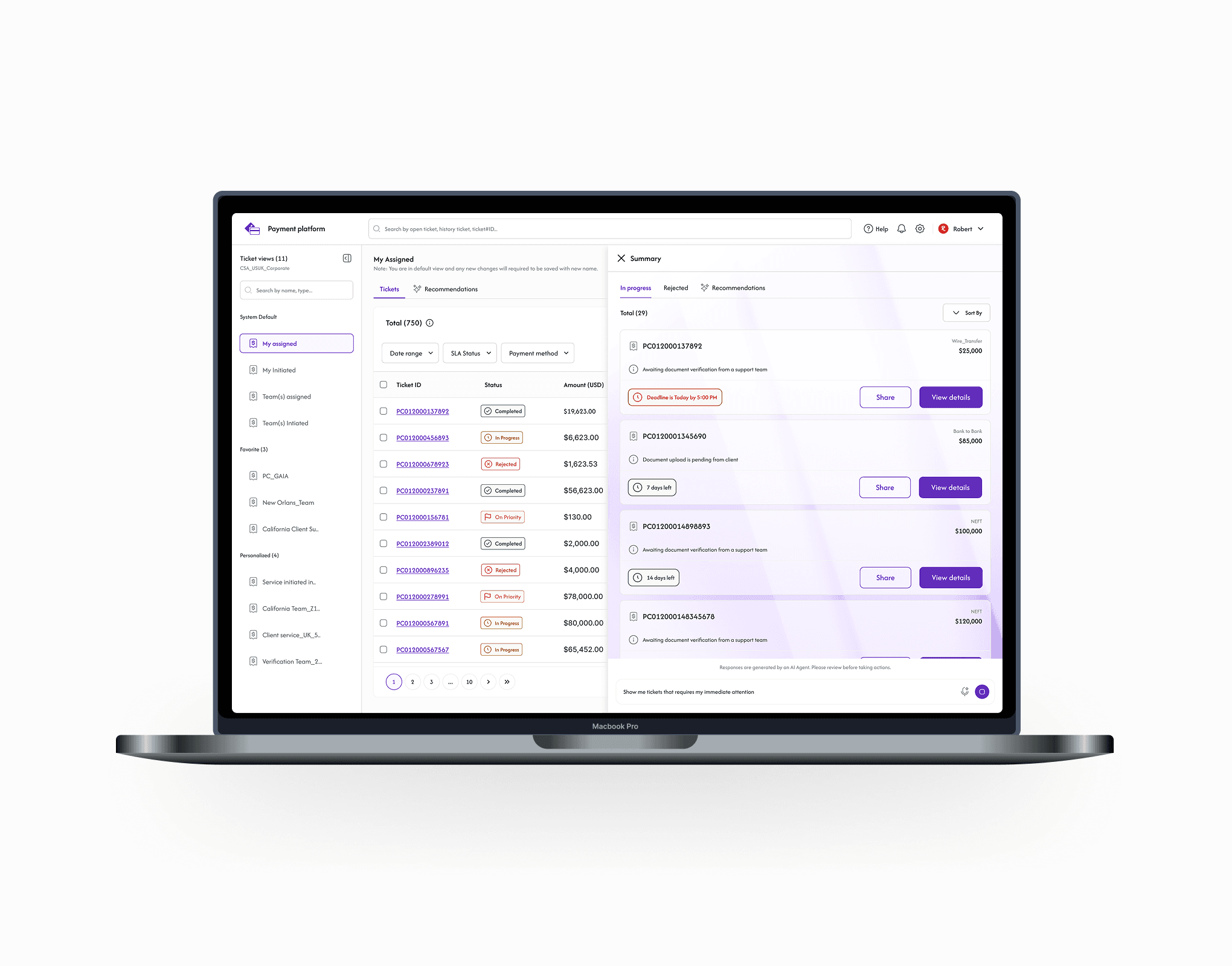


This transformation repositions the Payment Blotter from a complex data table into a structured operational command center.
This transformation repositions the Payment Blotter from a complex data table into a structured operational command center.
AI adoption improved when workflows supported existing operational behavior instead of trying to replace it entirely. The project strengthened my approach toward designing enterprise AI systems by balancing operational workflows, business constraints, and human decision-making at scale.
Impact
4 Star (from 2.5 star)
Impact
4 Star (from 2.5 star)
Impact
80% (CSAT Score)
Impact
80% (CSAT Score)
Impact
<4 mins (closure)
Impact
<4 mins (closure)
Impact
<6% (drop-off)
Impact
<6% (drop-off)
Explore Projects


AI Powered Payments Platform
Transformed a complex payment blotter into an AI-assisted workspace by cutting task time to <3 minutes, reduced ticket allocation per team <1500.
AI Powered Payments Platform
Transformed a complex payment blotter into an AI-assisted workspace by cutting task time to <3 minutes, reduced ticket allocation per team <1500.
AI Powered Payments Platform
Transformed a complex payment blotter into an AI-assisted workspace by cutting task time to <3 minutes, reduced ticket allocation per team <1500.
Status & Year
Awarded (2025-26)
Status
Awarded (2025-26)
Status & Year
Awarded (2025-26)
Company
JP Morgan
Company
JP Morgan
Disclaimer
This project is based on real-world experience in a regulated enterprise environment. Sensitive data, system identifiers, and workflows have been modified to maintain confidentiality.
Problem Statement & Challenges
JP Morgan’s payment operations teams handled thousands of daily escalations across fragmented workflows, where operational associates relied heavily on manual prioritization and repetitive investigation patterns.
The challenge was to improve operational efficiency and decision-making speed without disrupting legacy enterprise systems or compliance-sensitive workflows.
My Contribution
Led end-to-end product design across discovery, workflow mapping, AI-assisted interactions, prototyping, and validation. Partnered closely with research, product, operations, and engineering teams to define scope, validate workflows, and support implementation.
Design
1 Member
Design
1 Member
Product
2 Member
Product
2 Member
Engg+Data+Ops
3 Member
Engg+Data+Ops
3 Member
Timeline
2 Sprints
Timeline
2 Sprints
Persona, Jobs to be done
16+ one-on-one interviews, survey with 250+ respondent, 300~ session logs studied & conducted existing product audit.
These roles operate in environments that are high-risk, time-sensitive, and compliance-driven, where even minor ambiguity can delay resolution or escalate risk.
Despite varying responsibilities, a consistent pattern emerged: the system provided data, but not clarity.
Our North Star
To transform the blotter from a dense monitoring interface into a structured operational workspace.
The goal was to reduce cognitive load, improve decision confidence, and preserve enterprise-level depth while making the system feel coherent, not overwhelming.
Field interaction
16 Interviews
Research
16 Interviews
Field interaction
16 Interviews
System logs
300 Sessions
System logs
300 Sessions
Sample
4+ Offices
Sample
4+ Offices
Mapping & Analysis
4 Days
Mapping & Analysis
4 Days
We began by mapping existing user journeys, auditing listing logic, and identifying inconsistency across roles and access layers. Whiteboard sessions uncovered how visibility rules and legacy decisions created fragmentation.
Why AI?
The problem was not lack of operational data it was the inability to surface the right information at the right moment within time-sensitive workflows.
AI was introduced as an operational co-pilot to prioritize actions, surface contextual recommendations, and reduce manual investigation effort without replacing human decision-making.
Ideate, Test & Measure
The new flow organizes payment data through clearer hierarchy and structured states. Role-aware access is surfaced transparently rather than buried in system logic. Ticket handling is embedded directly within contextual views, reducing back-and-forth navigation.
The new flow organizes payment data through clearer hierarchy and structured states. Role-aware access is surfaced transparently rather than buried in system logic. Ticket handling is embedded directly within contextual views, reducing back-and-forth navigation.
Key Trade-offs
Guided operational workflows over open-ended conversations
Workflow familiarity over full-system redesign
AI-assisted prioritization over autonomous decision-making
Lightweight integration over large-scale platform replacement
This transformation repositions the Payment Blotter from a complex data table into a structured operational command center.
This transformation repositions the Payment Blotter from a complex data table into a structured operational command center.
AI adoption improved when workflows supported existing operational behavior instead of trying to replace it entirely. The project strengthened my approach toward designing enterprise AI systems by balancing operational workflows, business constraints, and human decision-making at scale.
Impact
4 Star (from 2.5 star)
Impact
4 Star (from 2.5 star)
Impact
80% (CSAT Score)
Impact
80% (CSAT Score)
Impact
<4 mins (closure)
Impact
<4 mins (closure)
Impact
<6% (drop-off)
Impact