
Agentic workflow platform
AI-guided workflow experience reduced workflow complexity, driving a projected 40% faster workflow creation, 60% lower onboarding effort, and 35% fewer workflow configuration errors.
Agentic workflow platform
AI-guided workflow experience reduced workflow complexity, driving a projected 40% faster workflow creation, 60% lower onboarding effort, and 35% fewer workflow configuration errors.
Agentic workflow platform
AI-guided workflow experience reduced workflow complexity, driving a projected 40% faster workflow creation, 60% lower onboarding effort, and 35% fewer workflow configuration errors.
Status & Year
Development (2026-27)
Status
Development (2026-27)
Status & Year
Development (2026-27)
Company
Dentsu
Company
Dentsu
Disclaimer
To respect confidentiality, selected product details, workflows, metrics, and visuals have been adapted for this case study. The design process, product thinking, and outcomes accurately reflect my contribution while preserving the project's overall direction.
Problem Statement & Challenges
Users relied on multiple tools to configure agents, connect workflows, and understand execution logic, creating unnecessary cognitive load throughout the workflow creation journey.
Business opportunity
With the global AI market projected to exceed $1.8 trillion by 2030 and enterprise adoption accelerating across engineering, operations, and customer support, organizations are increasingly investing in AI-native platforms to improve productivity and operational efficiency.
Problem
The existing workflow builder required users to manually configure nodes, understand technical dependencies, and navigate multiple tools to create production-ready workflows.
This increased cognitive load, slowed workflow creation, and created adoption challenges as AI capabilities continued to expand.
To address this, we reimagined the experience as an AI-native workflow platform that guides users from idea to deployment through conversational assistance, visual workflow creation, and production-ready automation.
My Contribution
Led the end-to-end product design of an AI-native workflow platform, from discovery through engineering handoff.
Working closely with Product Managers, AI Engineers, and Developers, I led user research, product strategy, workflow architecture, interaction design, design systems, prototyping, and validation to redesign the experience around conversational AI, visual workflow building, and guided automation.
The outcome was a production-ready Phase 1 experience that simplifies workflow creation while providing a scalable foundation for future agentic capabilities
Design
1 Member
Design
1 Member
Product
1 Member
Product
1 Member
Engg+Data+Ops
2 Member
Engg+Data+Ops
2 Member
Timeline
2 Sprints
Timeline
2 Sprints


Persona, Jobs to be done
Research included an audit of 10+ workflow screens, heuristic evaluation (5.9/10), competitive benchmarking across 4+ enterprise AI workflow platforms, and visual experience analysis (4/10) to uncover usability gaps, reduce cognitive load, and define opportunities for a more intuitive workflow creation experience.
Primary Users
AI Engineers, Technical Leads, and Business Analysts responsible for building and maintaining production AI workflows.
They frequently configure workflows, connect multiple services, and troubleshoot execution issues.
Secondary Users
Low-code builders, Operations teams, and Product Managers creating business workflows with limited technical expertise.
They needed a guided workflow creation experience that reduced the learning curve while providing enough flexibility to build, test, and deploy AI-powered automations confidently.
Prioritization
The Phase 1 MVP focused on simplifying workflow creation by reducing configuration complexity, improving visual clarity, and guiding users through each step of the workflow-building journey.
Rather than replacing user decisions, AI was designed to assist with workflow generation, configuration, and troubleshooting while keeping users in complete control.
Key Constraints
Flexibility vs. Simplicity: Support both technical and low-code users without oversimplifying advanced workflow capabilities.
Engineering Feasibility: Design reusable workflow components and AI capabilities that could be implemented incrementally within the existing platform architecture.
Performance: Maintain a responsive visual builder while handling increasingly complex workflow structures and AI-assisted interactions.
Trust & Transparency: Clearly communicate workflow status, execution progress, configuration errors, and AI-generated suggestions so users always understood what the platform was doing.
Scalability: Establish a modular workflow architecture capable of supporting additional AI agents, integrations, and enterprise-scale workflows in future releases.
Our North Star
User Needs
Power Users (Primary)
Needed a faster way to build, configure, test, and deploy AI workflows while maintaining flexibility, visibility, and control over complex workflow logic.
New Users (Secondary)
Needed guided workflow creation, contextual assistance, and clear next-step guidance to reduce the learning curve and confidently build AI workflows without extensive technical knowledge.
User wants
Power Users (Primary)
Wanted reusable workflow templates, faster debugging, production-ready configurations, and AI assistance that accelerated repetitive tasks without limiting customization.
New Users (Secondary)
Wanted an intuitive visual builder, conversational guidance, and contextual recommendations that made workflow creation approachable without relying on documentation.
Goal
Our goal was to simplify AI workflow creation by helping users build, configure, and deploy production-ready workflows with greater confidence through guided interactions, visual clarity, and AI-assisted automation while reducing learning effort without compromising the flexibility required by enterprise teams.
Field interaction
16+ Interacted
Research
16+ Interacted
Field interaction
16+ Interacted
System logs
2 Markets
System logs
2 Markets
Sample
2 Locations
Sample
2 Locations
Mapping & Analysis
4 days
Mapping & Analysis
4 days


The solution evolved through multiple workflow explorations, rapid prototyping, and usability validation. We tested four navigation concepts with 8 participants, combining prototype testing, design critiques, card sorting, and A/B testing to identify the experience that best balanced discoverability, speed, and workflow clarity.
Validation
Validation included mid-design prototype testing with 8 participants, evaluating four workflow navigation concepts through design critiques, card sorting, and A/B testing. Participants completed the end-to-end workflow journey from creating a new workflow to configuring agents, testing execution, and exporting production-ready workflows.
Key success metrics included time-to-complete the first workflow, drop-off rate, hesitation points, confidence score, support interactions, and overall task success rate.
Learnings
Users preferred upfront clarity over feature density.
Right-side contextual panels kept the workflow canvas visible and reduced context switching.
AI build guidance improved confidence during workflow creation.
Transparent node states and execution feedback reduced hesitation during configuration.
Dense configuration panels increased cognitive load and slowed first-time workflow completion.
Ideate, Test & Measure

Over a two-week design sprint, four workflow concepts were rapidly iterated and validated with eight participants using a dedicated FigJam research board, mid-fidelity prototypes, design critiques, card sorting, and A/B testing.
Over a two-week design sprint, four workflow concepts were rapidly iterated and validated with eight participants using a dedicated FigJam research board, mid-fidelity prototypes, design critiques, card sorting, and A/B testing.
Rapid Iteration
Throughout the design sprint, multiple workflow creation patterns were explored and refined using continuous user feedback and cross-functional collaboration.
Four navigation models including Side Drawer, Middle Pop-up, Right-side Tabs, and Configuration Side Panel were evaluated against usability, discoverability, engineering feasibility, and workflow efficiency.
Each concept was measured using time-to-complete, hesitation points, confidence score, support interactions, and overall task success before converging on the final experience.
Innovation Opportunities
The platform establishes a foundation for future AI-powered workflow experiences.
AI Workflow Co-builder
An intelligent assistant capable of generating complete workflow structures from natural language prompts while keeping users in control of every decision.
Adaptive Workflow Intelligence
Personalized recommendations based on workflow history, commonly used connectors, and organizational best practices.
Predictive Validation Engine
Proactively detects configuration issues, missing dependencies, and execution risks before workflows are deployed.
Design-to-Code Automation
Automatically transforms validated workflow designs into production-ready code, reducing engineering effort and accelerating deployment.


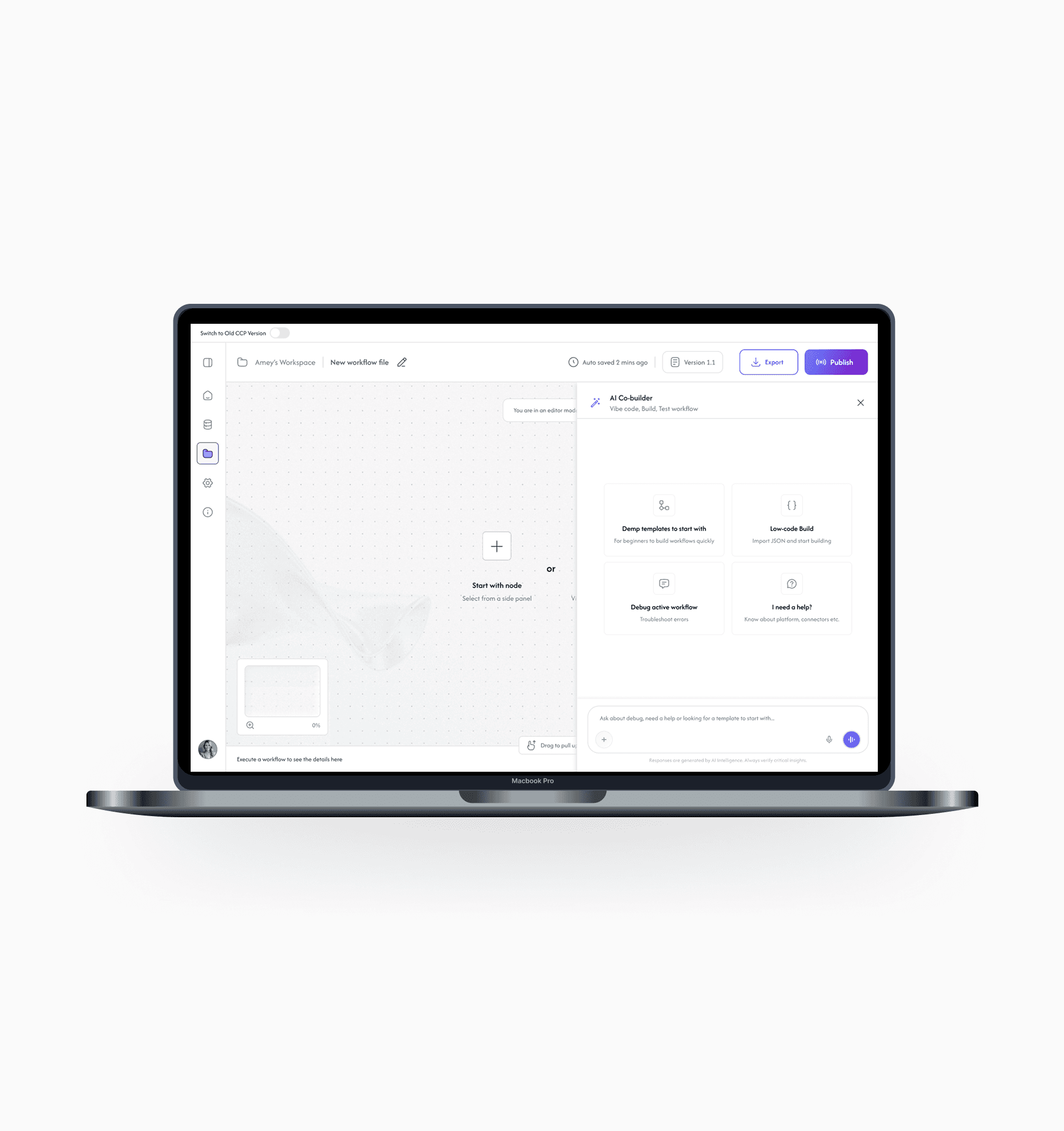


The solution tackled workflow complexity the biggest barrier to enterprise AI adoption by combining guided interactions, visual clarity, and AI-assisted workflow creation. Rather than automating decisions, the platform empowered users to build, configure, and deploy production-ready workflows with greater confidence and less cognitive effort.
The solution tackled workflow complexity the biggest barrier to enterprise AI adoption by combining guided interactions, visual clarity, and AI-assisted workflow creation. Rather than automating decisions, the platform empowered users to build, configure, and deploy production-ready workflows with greater confidence and less cognitive effort.
12-Month Roadmap
Phase 2 | AI Workflow Co-builder
Expand AI capabilities to generate complete workflow structures from natural language prompts, enabling users to move from ideas to production-ready workflows with minimal manual configuration.
Phase 3 | Adaptive Workflow Intelligence
Introduce personalized recommendations based on workflow history, frequently used connectors, and organizational best practices to accelerate workflow creation while preserving user control.
Phase 4 | Autonomous Workflow Optimization
Enable the platform to proactively detect workflow inefficiencies, recommend optimizations, identify configuration risks, and improve execution reliability through continuous AI-driven insights.
Phase 5 | Multi-Agent Orchestration
Extend the workflow builder to support collaborative AI agents capable of planning, executing, monitoring, and optimizing complex enterprise workflows across multiple systems.
Reflection
This project reinforced that designing AI products is not about replacing users it's about reducing complexity while preserving confidence and control.
The biggest challenge wasn't adding more AI capabilities, but presenting them in a way that felt transparent, predictable, and approachable for both experienced engineers and first-time workflow builders.
Impact
<30 mins to build time
Impact
<30 mins to build time
Impact
+35% workflow exports
Impact
+35% workflow exports
Impact
<30% build time drop-off
Impact
<30% build time drop-off
Impact
~75% completion rate
Impact
~75% completion rate
Explore Projects


Agentic workflow platform
AI-guided workflow experience reduced workflow complexity, driving a projected 40% faster workflow creation, 60% lower onboarding effort, and 35% fewer workflow configuration errors.
Agentic workflow platform
AI-guided workflow experience reduced workflow complexity, driving a projected 40% faster workflow creation, 60% lower onboarding effort, and 35% fewer workflow configuration errors.
Agentic workflow platform
AI-guided workflow experience reduced workflow complexity, driving a projected 40% faster workflow creation, 60% lower onboarding effort, and 35% fewer workflow configuration errors.
Status & Year
Development (2026-27)
Status
Development (2026-27)
Status & Year
Development (2026-27)
Company
Dentsu
Company
Dentsu
Disclaimer
To respect confidentiality, selected product details, workflows, metrics, and visuals have been adapted for this case study. The design process, product thinking, and outcomes accurately reflect my contribution while preserving the project's overall direction.
Problem Statement & Challenges
Users relied on multiple tools to configure agents, connect workflows, and understand execution logic, creating unnecessary cognitive load throughout the workflow creation journey.
Business opportunity
With the global AI market projected to exceed $1.8 trillion by 2030 and enterprise adoption accelerating across engineering, operations, and customer support, organizations are increasingly investing in AI-native platforms to improve productivity and operational efficiency.
Problem
The existing workflow builder required users to manually configure nodes, understand technical dependencies, and navigate multiple tools to create production-ready workflows.
This increased cognitive load, slowed workflow creation, and created adoption challenges as AI capabilities continued to expand.
To address this, we reimagined the experience as an AI-native workflow platform that guides users from idea to deployment through conversational assistance, visual workflow creation, and production-ready automation.
My Contribution
Led the end-to-end product design of an AI-native workflow platform, from discovery through engineering handoff.
Working closely with Product Managers, AI Engineers, and Developers, I led user research, product strategy, workflow architecture, interaction design, design systems, prototyping, and validation to redesign the experience around conversational AI, visual workflow building, and guided automation.
The outcome was a production-ready Phase 1 experience that simplifies workflow creation while providing a scalable foundation for future agentic capabilities
Design
1 Member
Design
1 Member
Product
1 Member
Product
1 Member
Engg+Data+Ops
2 Member
Engg+Data+Ops
2 Member
Timeline
2 Sprints
Timeline
2 Sprints
Persona, Jobs to be done
Research included an audit of 10+ workflow screens, heuristic evaluation (5.9/10), competitive benchmarking across 4+ enterprise AI workflow platforms, and visual experience analysis (4/10) to uncover usability gaps, reduce cognitive load, and define opportunities for a more intuitive workflow creation experience.
Primary Users
AI Engineers, Technical Leads, and Business Analysts responsible for building and maintaining production AI workflows.
They frequently configure workflows, connect multiple services, and troubleshoot execution issues.
Secondary Users
Low-code builders, Operations teams, and Product Managers creating business workflows with limited technical expertise.
They needed a guided workflow creation experience that reduced the learning curve while providing enough flexibility to build, test, and deploy AI-powered automations confidently.
Prioritization
The Phase 1 MVP focused on simplifying workflow creation by reducing configuration complexity, improving visual clarity, and guiding users through each step of the workflow-building journey.
Rather than replacing user decisions, AI was designed to assist with workflow generation, configuration, and troubleshooting while keeping users in complete control.
Key Constraints
Flexibility vs. Simplicity: Support both technical and low-code users without oversimplifying advanced workflow capabilities.
Engineering Feasibility: Design reusable workflow components and AI capabilities that could be implemented incrementally within the existing platform architecture.
Performance: Maintain a responsive visual builder while handling increasingly complex workflow structures and AI-assisted interactions.
Trust & Transparency: Clearly communicate workflow status, execution progress, configuration errors, and AI-generated suggestions so users always understood what the platform was doing.
Scalability: Establish a modular workflow architecture capable of supporting additional AI agents, integrations, and enterprise-scale workflows in future releases.
Our North Star
User Needs
Power Users (Primary)
Needed a faster way to build, configure, test, and deploy AI workflows while maintaining flexibility, visibility, and control over complex workflow logic.
New Users (Secondary)
Needed guided workflow creation, contextual assistance, and clear next-step guidance to reduce the learning curve and confidently build AI workflows without extensive technical knowledge.
User wants
Power Users (Primary)
Wanted reusable workflow templates, faster debugging, production-ready configurations, and AI assistance that accelerated repetitive tasks without limiting customization.
New Users (Secondary)
Wanted an intuitive visual builder, conversational guidance, and contextual recommendations that made workflow creation approachable without relying on documentation.
Goal
Our goal was to simplify AI workflow creation by helping users build, configure, and deploy production-ready workflows with greater confidence through guided interactions, visual clarity, and AI-assisted automation while reducing learning effort without compromising the flexibility required by enterprise teams.
Field interaction
16+ Interacted
Research
16+ Interacted
Field interaction
16+ Interacted
System logs
2 Markets
System logs
2 Markets
Sample
2 Locations
Sample
2 Locations
Mapping & Analysis
4 days
Mapping & Analysis
4 days
The solution evolved through multiple workflow explorations, rapid prototyping, and usability validation. We tested four navigation concepts with 8 participants, combining prototype testing, design critiques, card sorting, and A/B testing to identify the experience that best balanced discoverability, speed, and workflow clarity.
Validation
Validation included mid-design prototype testing with 8 participants, evaluating four workflow navigation concepts through design critiques, card sorting, and A/B testing. Participants completed the end-to-end workflow journey from creating a new workflow to configuring agents, testing execution, and exporting production-ready workflows.
Key success metrics included time-to-complete the first workflow, drop-off rate, hesitation points, confidence score, support interactions, and overall task success rate.
Learnings
Users preferred upfront clarity over feature density.
Right-side contextual panels kept the workflow canvas visible and reduced context switching.
AI build guidance improved confidence during workflow creation.
Transparent node states and execution feedback reduced hesitation during configuration.
Dense configuration panels increased cognitive load and slowed first-time workflow completion.
Ideate, Test & Measure
Over a two-week design sprint, four workflow concepts were rapidly iterated and validated with eight participants using a dedicated FigJam research board, mid-fidelity prototypes, design critiques, card sorting, and A/B testing.
Over a two-week design sprint, four workflow concepts were rapidly iterated and validated with eight participants using a dedicated FigJam research board, mid-fidelity prototypes, design critiques, card sorting, and A/B testing.
Rapid Iteration
Throughout the design sprint, multiple workflow creation patterns were explored and refined using continuous user feedback and cross-functional collaboration.
Four navigation models including Side Drawer, Middle Pop-up, Right-side Tabs, and Configuration Side Panel were evaluated against usability, discoverability, engineering feasibility, and workflow efficiency.
Each concept was measured using time-to-complete, hesitation points, confidence score, support interactions, and overall task success before converging on the final experience.
Innovation Opportunities
The platform establishes a foundation for future AI-powered workflow experiences.
AI Workflow Co-builder
An intelligent assistant capable of generating complete workflow structures from natural language prompts while keeping users in control of every decision.
Adaptive Workflow Intelligence
Personalized recommendations based on workflow history, commonly used connectors, and organizational best practices.
Predictive Validation Engine
Proactively detects configuration issues, missing dependencies, and execution risks before workflows are deployed.
Design-to-Code Automation
Automatically transforms validated workflow designs into production-ready code, reducing engineering effort and accelerating deployment.
The solution tackled workflow complexity the biggest barrier to enterprise AI adoption by combining guided interactions, visual clarity, and AI-assisted workflow creation. Rather than automating decisions, the platform empowered users to build, configure, and deploy production-ready workflows with greater confidence and less cognitive effort.
The solution tackled workflow complexity the biggest barrier to enterprise AI adoption by combining guided interactions, visual clarity, and AI-assisted workflow creation. Rather than automating decisions, the platform empowered users to build, configure, and deploy production-ready workflows with greater confidence and less cognitive effort.
12-Month Roadmap
Phase 2 | AI Workflow Co-builder
Expand AI capabilities to generate complete workflow structures from natural language prompts, enabling users to move from ideas to production-ready workflows with minimal manual configuration.
Phase 3 | Adaptive Workflow Intelligence
Introduce personalized recommendations based on workflow history, frequently used connectors, and organizational best practices to accelerate workflow creation while preserving user control.
Phase 4 | Autonomous Workflow Optimization
Enable the platform to proactively detect workflow inefficiencies, recommend optimizations, identify configuration risks, and improve execution reliability through continuous AI-driven insights.
Phase 5 | Multi-Agent Orchestration
Extend the workflow builder to support collaborative AI agents capable of planning, executing, monitoring, and optimizing complex enterprise workflows across multiple systems.
Reflection
This project reinforced that designing AI products is not about replacing users it's about reducing complexity while preserving confidence and control.
The biggest challenge wasn't adding more AI capabilities, but presenting them in a way that felt transparent, predictable, and approachable for both experienced engineers and first-time workflow builders.
Impact
<30 mins to build time
Impact
<30 mins to build time
Impact
+35% workflow exports
Impact
+35% workflow exports
Impact
<30% build time drop-off
Impact
<30% build time drop-off
Impact
~75% completion rate
Impact